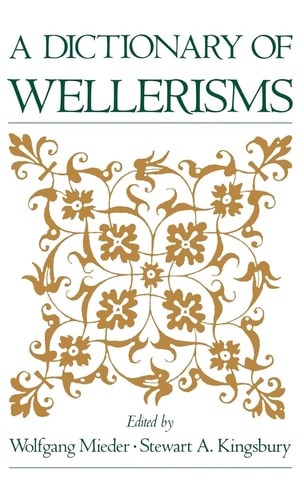
A Dictionary of Wellerisms
0
0
As an Amazon Associate and affiliate partner, Menrva Books earns from qualifying purchases. Learn more
Author Description
The wellerism--so called in English because it is a form of expression typical or reminiscent of Sam Weller or his father, two celebrated characters in Dickens's Pickwick Papers--is a major subtype of the proverb. Known since Sumerian times, it has been popular in most European languages and some African languages. As defined by folklorists and proverb scholars, a wellerism consists of three parts: a speech or statement (often a proverb), identification of the speaker, and identification of the situation, which gives the expression an ironic or humorous twist, often in the form of a pun.BL "Prevention is better than cure," said the pig when it ran away from the butcher.BL "We'll have to rehearse that," said the undertaker as the coffin fell out of the car.A Dictionary of Wellerisms is the first work to collect all of the wellerisms recorded in the English language. Drawing on periodical literature and other scholarly sources, Mieder and Kingsbury have assembled, edited, and annotated a collection of wellerisms including over 1500 texts found in British, American, Canadian, and other English-language literatures and oral collections. Mieder's preface, bibliography, and extensive introduction explaining the history, meaning, and function of wellerisms, are supplemented by an index of speakers and an index of situations.Containing a wealth of wit and humor, A Dictionary of Wellerisms is both entertaining and informative, appealing to the casual browser as well as to students and scholars of literature, psychology, folklore, linguistics, anthropology, and cultural history.
Menrva's Summary
THE THESIS
This work investigates the historical evolution, structural mechanics, and cultural function of the wellerism as a distinct subtype of the proverb. The authors, both established scholars in the field of paremiology, utilize a vast array of primary source material, including periodical literature and oral traditions, to define the tripartite structure of these expressions. By analyzing the interplay between the statement, the speaker, and the situational context, the text provides a comprehensive framework for understanding how irony and humor are encoded in linguistic tradition.
THE SCOPE MAP
What You Will Find
- A collection of over 1500 wellerisms sourced from British, American, and Canadian literature and oral traditions.
- A detailed historical introduction tracing the form from Sumerian origins to modern usage.
- Scholarly indices categorized by speaker and situation for comparative analysis.
- A comprehensive bibliography and preface detailing the methodology of proverb collection.
THE AUTHORITY PERSPECTIVE
Experts in folklore and linguistics recognize this volume as a foundational reference for the study of proverbial forms. Readers frequently note the academic rigor of the annotations while appreciating the accessibility of the humor contained within the entries.
Page Count:
208
Publication Date:
1994-02-17
Publisher:
Oxford University Press
ISBN-10:
0195083180
ISBN-13:
9780195083187
Humor
Reference
Folklore
Linguistics
Cultural History
Language
Proverbs
Community Tags
Similar Books