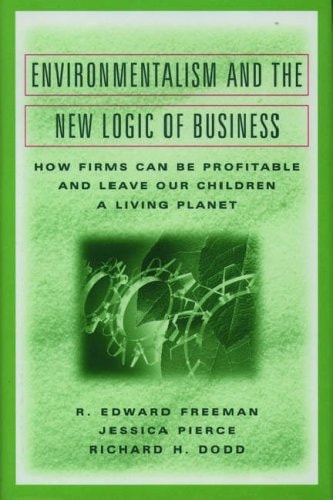
Environmentalism and the New Logic of Business
0
0
As an Amazon Associate and affiliate partner, Menrva Books earns from qualifying purchases. Learn more
Author Description
The Exxon Valdez incident in 1989 sparked a firestorm of public debate over the role of business in ensuring a safe, healthy environment for ourselves and our children. Today, consumers, employees, shareholders, politicians, and interest groups all demand more environmental awareness from business.To help executives meet the challenge of being profitable, doing the right thing, and helping save the Earth, Environmentalism and the New Logic of Business outlines a program for change that firms can use to maximize their profits and minimize their impact on the environment. Drawing on examples from corporations large (DuPont, McDonald's) and small (Johnsonville Sausage), the authors demonstrate how companies around the world are putting values and a concern for the environment to work to motivate employees, improve service levels, and respond to the constant pressure for innovation, competitive advantage, and care for the bottom line. A highlight of the book is the author's discussion of "the four shades of green" which can be used to gauge of firm's environmental policy and highlight where it might be improved. "Light green" or legal green logic relies on the public policy process to drive its strategy; "market green" logic focuses on customers' demand for better, cheaper, faster; "stakeholder green," similar to the logic of quality processes, includes suppliers, employees, communities, and shareholders; and "dark green" commits a company to being a leader in making environmental principles a fundamental basis of doing business.Challenging the conventional wisdom that green thinking leads to red ink, the authors show how executives can add environmental awareness to the strategic mix and still compete successfully.
Menrva's Summary
THE THESIS
This book investigates how corporations can integrate environmental responsibility into their core business strategies to achieve both profitability and ecological sustainability. The authors, including R. Edward Freeman, a prominent figure in stakeholder theory, argue that environmental awareness is not a hindrance to financial success but a driver of innovation and competitive advantage. By moving beyond traditional profit-only models, the text provides a framework for executives to align corporate values with the increasing demands of stakeholders, including employees, shareholders, and the public.
THE SCOPE MAP
What You Will Find
- The four shades of green framework for evaluating corporate environmental policy.
- Case studies of large and small corporations such as DuPont, McDonald's, and Johnsonville Sausage.
- Strategies for aligning environmental initiatives with employee motivation and service improvement.
- Methodologies for balancing bottom-line financial goals with ecological impact reduction.
THE AUTHORITY PERSPECTIVE
Experts recognize this work as a foundational text for understanding the evolution of corporate environmental strategy in the post-Exxon Valdez era. Readers frequently note the clarity of the 'four shades of green' framework as a practical tool for organizational assessment.
Page Count:
146
Publication Date:
2000-05-15
Publisher:
Oxford University Press
ISBN-10:
0195080939
ISBN-13:
9780195080933
Business
Sustainability
Management
Community Tags
Similar Books