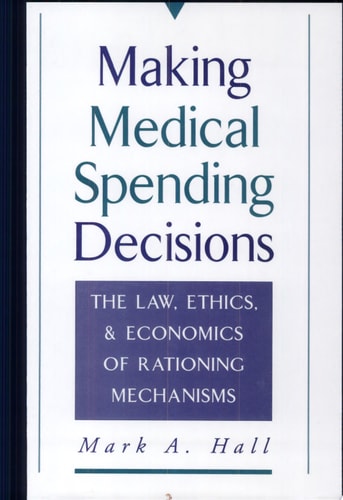
Making Medical Spending Decisions: The Law, Ethics, and Economics of Rationing Mechanisms
0
0
As an Amazon Associate and affiliate partner, Menrva Books earns from qualifying purchases. Learn more
Author Description
A fresh and comprehensive exploration of how health care rationing decisions are made, this book offers not specific criteria for rationing--like age or quality of life--but a comparative analysis of three alternative decision makers: consumers paying out of pocket, government and insurance officials setting limits on treatments and coverage, and physicians making decisions at the bedside. Hall's analysis reveals that none of these alternatives is uniformly superior, and, therefore, a mix of all three is inevitable.The author develops his analysis along three lines of reasoning: political economics, ethics, and law. The economic dimension addresses the practical feasibility of each method for making spending decisions. The ethical dimension discusses several theories--principally classic liberalism, social contract theory, and communitarianism--as well as concepts like autonomy and coercion. The legal dimension follows recent developments in legal doctrine such as informed consent, insurance coverage disputes, and the emerging direction of federal regulation. Hall concludes that physician rationing at the bedside is far more promising than medical ethicists and the medical profession have traditionally allowed.
Menrva's Summary
THE THESIS
This book investigates the optimal mechanisms for health care rationing by evaluating the comparative efficacy of consumers, government officials, and physicians in making medical spending decisions. Mark A. Hall, a legal scholar specializing in health care, utilizes a multidisciplinary framework to assess these decision-making models. By integrating political economics, ethical theory, and legal doctrine, the author argues that no single rationing method is sufficient, necessitating a hybrid approach that reevaluates the role of the physician at the bedside.
THE SCOPE MAP
What You Will Find
- Comparative analysis of three primary rationing agents: individual consumers, administrative officials, and bedside physicians.
- Application of political economic theory to determine the practical feasibility of various spending constraints.
- Ethical evaluation based on classic liberalism, social contract theory, and communitarianism.
- Legal review of informed consent, insurance coverage litigation, and federal regulatory trends.
THE AUTHORITY PERSPECTIVE
Experts recognize this work as a foundational text for understanding the intersection of health policy and clinical ethics. Readers frequently note the academic density of the prose, which provides a rigorous examination of the structural challenges inherent in medical resource allocation.
Page Count:
300
Publication Date:
1997-01-15
Publisher:
Oxford University Press
ISBN-10:
0195092198
ISBN-13:
9780195092196
Economics
Medical Ethics
Law
Public Policy
Health Care
Community Tags
Similar Books