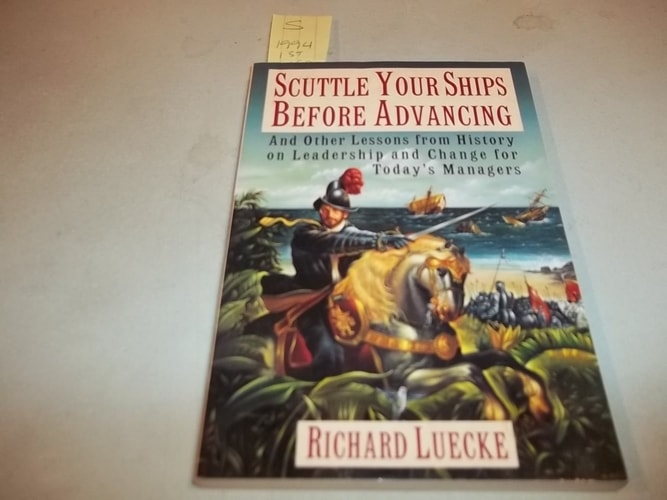
Scuttle Your Ships before Advancing: And Other Lessons from History on Leadership and Change for Today's Managers
0
0
As an Amazon Associate and affiliate partner, Menrva Books earns from qualifying purchases. Learn more
Author Description
In the spring of 1942, Japan's Admiral Yamamoto devised an ingenious strategy to attack Midway Island and deliver the knockout punch of the war in the Pacific. His elegant operational plan--which involved elaborate traps and diversions and required clockwork coordination--was founded on complete faith that he could predict the Americans' every move. But the perfect plan went wrong, and Japan's elite Strike Force was crushed, losing four carriers, over three hundred aircraft, and 2,500 men.What can today's business managers learn from Yamamoto's stunning defeat at the Battle of Midway? A great deal, according to Richard Luecke, and in Scuttle Your Ships Before Advancing, he illuminates lessons to be learned from Yamamoto and other leaders who have faced memorable crises. We find, for instance, the epitome of decisiveness and entrepreneurialism in Hernan Cortes, as he and a small band of 16th-century adverturers risked everything in a bold gamble for the Aztec empire (the book's title, Scuttle Your Ships, refers to Cortes' strategy that kept his men moving forward). Underdogs who would challenge the status quo can look to France's Louis XI, the "Spider King," and learn how he undermined entrenched rivals through patience and cunning. The Emperor Hadrian, in his consolidation of the sprawling Roman Empire, provides a brilliant model for managing today's multinational corporation. And attitudes toward technology and innovation are vividly illustrated by the 15th-century Battle of Agincourt, in which the stubborn refusal of the French to adopt their English enemy's weapon--the longbow--led to their massacre. From these and other historical episodes, Luecke shows how leadership, daring, and artful administration meant the difference between success and failure. He draws explicit lessons for managers from these long-ago events, and he also reveals parallels in the recent experiences of major corporations from GM to Shearson Lehman. And along the way, he evokes portraits of
Menrva's Summary
THE THESIS
Can historical precedents provide actionable frameworks for modern corporate management and organizational change? Richard A. Luecke, an experienced business writer, utilizes historical case studies to extract universal principles of leadership, risk management, and strategic adaptation. By juxtaposing the failures and successes of figures like Admiral Yamamoto, Hernan Cortes, and Emperor Hadrian against contemporary corporate challenges, the author argues that the fundamental dynamics of power and decision-making remain constant across centuries.
THE SCOPE MAP
What You Will Find
- Historical case studies including the Battle of Midway, the conquest of the Aztec empire, and the Battle of Agincourt.
- Comparative analysis between historical military or political crises and modern corporate scenarios.
- Methodologies for managing multinational organizations and navigating technological disruption.
- Lessons on decisiveness, patience, and the strategic necessity of eliminating retreat options.
THE AUTHORITY PERSPECTIVE
Readers frequently note the accessible nature of the historical narratives, which effectively bridge the gap between military history and business theory. Experts highlight this as a useful resource for managers seeking to apply classical strategic thinking to modern organizational problems.
Page Count:
208
Publication Date:
1995-06-15
Publisher:
Oxford University Press
ISBN-10:
0195096428
ISBN-13:
9780195096422
Business
History
Management
Strategy
Leadership
Community Tags
Similar Books






Reader Comments
Share Your Thoughts
No comments yet. Be the first to share your thoughts!