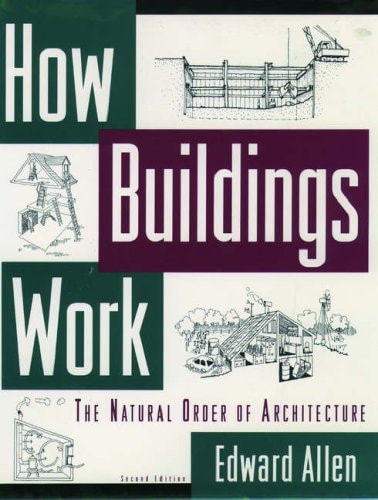
How Buildings Work: The Natural Order of Architecture
0
0
As an Amazon Associate and affiliate partner, Menrva Books earns from qualifying purchases. Learn more
Author Description
We expect our buildings to do many things: stand up, shelter us from weather, keep us comfortable, provide clean water for drinking and clean air for breathing, dispose of our wastes, give us privacy and security, power everything from tools to toasters, and connect us with the world outside through windows, doors, telephones, and mailboxes. They should be easy to move around in, and shouldn't require excessive expense to maintain.But how does a building do all this? This is the question Edward Allen addresses so engagingly in the completely revised and updated second edition of How Buildings Work. Illustrated throughout with several hundred clear, sometimes whimsical line drawings, more than half of them from the author's own hand, this easy-to-read work reveals virtually every secret of a building's function: how it stands up, keeps its occupants safe and comfortable, gets built, grows old, and dies--and why some buildings do this so much better than others. Everyone who has ever asked such questions as "why can't they get the temperature right in here?" "why does my basement flood every summer?" or "can't they build buildings so I don't have to hear my neighbors argue every morning?" will find an answer here.Drawing on things he's learned from the more than sixty buildings he himself designed, including his own house, Allen explains complex phenomena such as the role of the sun in heating buildings and the range of structural devices that are used for support, from trusses and bearing walls to post-tensioned concrete beams and corbeled vaults. He stresses the importance of intelligent design in dealing with such problems as overheating and overcooling, excessive energy use, leaky roofs and windows, fire safety, and noisy interiors, showing, for example, how to use the structure itself to mask troublesome noises such as the impact of rain, slamming doors, and the occasional creaks and groans caused by the push and pull of heat and humidity. And he illustrates how
Menrva's Summary
THE THESIS
This book investigates the fundamental mechanical and physical principles that allow buildings to function effectively as shelters and environments for human activity. Edward W. Allen, an experienced architect, utilizes his professional background and personal design experience to demystify the complex systems within modern structures. The text provides a comprehensive framework for understanding how buildings manage structural integrity, environmental control, and utility distribution through intelligent design choices.
THE SCOPE MAP
What You Will Find
- Analysis of structural support systems including trusses, bearing walls, and post-tensioned concrete.
- Methodologies for managing thermal comfort, energy efficiency, and moisture control.
- Practical explanations of building maintenance, aging, and acoustic management.
- Hundreds of illustrative line drawings detailing the physical components of residential and commercial architecture.
THE AUTHORITY PERSPECTIVE
Experts and readers frequently cite this work as a highly accessible introduction to building science that bridges the gap between professional engineering and layperson curiosity. The text is recognized for its clarity and the effective use of illustrative diagrams to explain complex architectural phenomena.
Page Count:
256
Publication Date:
1995-12-07
Publisher:
Oxford University Press
ISBN-10:
0195091000
ISBN-13:
9780195091007
Non-Fiction
Architecture
Construction
Methods & Materials
Design
House & Home
DESIGN General
Engineering
Professional Career & Trade
Community Tags
Similar Books