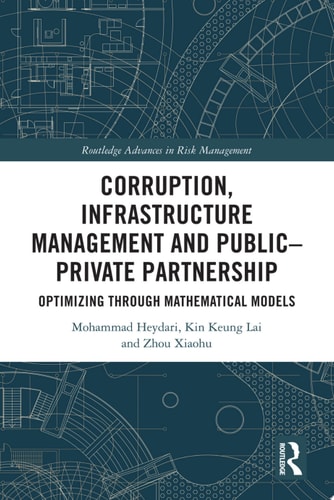
Corruption, Infrastructure Management and Public–Private Partnership Optimizing through Mathematical Models
0
0
As an Amazon Associate and affiliate partner, Menrva Books earns from qualifying purchases. Learn more
Author Description
Public–Private Partnerships (PPP or 3Ps) allow the public sector to seek alternative funding and expertise from the private sector during procurement processes. Such partnerships, if executed with due diligence, often benefit the public immensely. Unfortunately, Public–Private Partnerships can be vulnerable to corruption. This book looks at what measures we can put in place to check corruption during procurement and what good governance strategies the public sector can adopt to improve the performance of 3Ps. The book applies mathematical models to analyze 3Ps. It uses game theory to study the interaction and dynamics between the stakeholders and suggests strategies to reduce corruption risks in various 3Ps stages. The authors explain through game theory-based simulation how governments can adopt a evaluating process at the start of each procurement to weed out undesirable private partners and why the government should take a more proactive approach. Using a methodological framework rooted in mathematical models to illustrate how we can combat institutional corruption, this book is a helpful reference for anyone interested in public policymaking and public infrastructure management.
Menrva's Summary
THE THESIS
This book investigates how mathematical models can be employed to optimize public-private partnerships (PPPs) and mitigate corruption within infrastructure management. The authors, Kin Keung Lai, Mohammad Heydari, and Zhou Xiaohu, leverage their expertise to analyze the dynamics between public and private stakeholders in PPPs. By applying game theory and simulation, they propose strategies for governments to enhance due diligence in procurement, identify undesirable partners early, and foster good governance to improve PPP performance and combat institutional corruption.
THE SCOPE MAP
- Analysis of Public-Private Partnerships (PPPs) and their vulnerability to corruption.
- Application of mathematical models, specifically game theory, to analyze stakeholder interactions.
- Strategies for checking corruption during procurement processes.
- Good governance frameworks for improving PPP performance.
- Game theory-based simulations to illustrate evaluation processes for weeding out undesirable private partners.
- Proactive government approaches to PPP management.
- Methodological framework for combating institutional corruption through mathematical models.
THE AUTHORITY PERSPECTIVE
This book offers a rigorous, model-driven approach to understanding and improving public-private partnerships, particularly in the context of infrastructure management and corruption prevention. The authors' application of game theory and simulation provides a unique analytical lens for policymakers and public administrators. The work is positioned as a valuable reference for those seeking to enhance transparency and efficiency in public procurement and infrastructure development.
Page Count:
264
Publication Date:
2021-10-27
Publisher:
Routledge
ISBN-10:
100046587X
ISBN-13:
9781000465877
Economics
Non-Fiction
Politics
Public Policy
Game theory
Public Administration
Mathematical Modeling
Community Tags
Similar Books