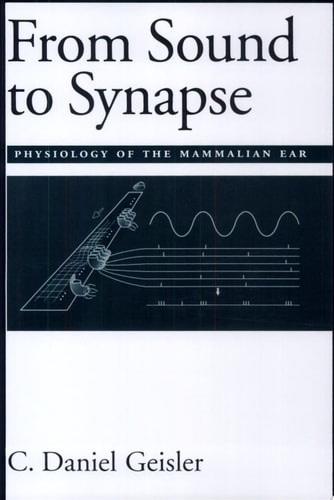
From Sound to Synapse: Physiology of the Mammalian Ear
0
0
As an Amazon Associate and affiliate partner, Menrva Books earns from qualifying purchases. Learn more
Author Description
This comprehensive introduction to the functions of the mammalian ear describes the major steps by which sound is transformed into nerve impulses. The author leads the reader along the pathway followed by the acoustic signal. He starts with the collection of sound by the outer ear, proceeds to its transfer by the middle ear, and finally analyzes its modification in the inner ear, where the sound waves are transformed into nerve impulses. The book concludes with descriptions of some common ear impairments and a brief survey of the treatments available for them.At each stage of the ear's sound processing, Professor Geisler discusses the basic mechanisms, covering current theories and illustrating the discussions with experimental data. Although he uses an extensive array of analogies and mathematical models, he considers only the basic theory and the outputs of the models, not their derivation or formal usage. Where appropriate, related mechanisms in the ears of other vertebrates are considered.From Sound to Synapse is written in lucid, accessible style that makes no assumptions about the scientific background of the reader apart from a basic familiarity with pulse generation by neurons. It will be of value to researchers and students in sensory physiology, neurophysiology, acoustics, bioengineering, psychoacoustics, and neuroscience. It will also benefit neurologists, audiologists, otolaryngologists, and other clinicians interested in a more detailed description of sound processing.
Menrva's Summary
THE THESIS
This text investigates the physiological mechanisms by which the mammalian ear converts acoustic signals into neural impulses. Professor C. Daniel Geisler, an expert in sensory physiology, utilizes a systematic approach to trace the pathway of sound from the outer ear through the middle and inner ear structures. By synthesizing experimental data with accessible mathematical models, the author provides a framework for understanding both healthy auditory function and common pathological impairments.
THE SCOPE MAP
What You Will Find
- Detailed analysis of sound transduction from the outer ear to the auditory nerve.
- Examination of mechanical and electrical processes within the cochlea.
- Comparative insights regarding auditory mechanisms in various vertebrate species.
- Overview of clinical ear impairments and contemporary therapeutic interventions.
THE AUTHORITY PERSPECTIVE
Experts and clinicians recognize this work as a foundational text for those seeking a clear, structured explanation of auditory processing. Readers frequently note that the prose remains accessible to students and professionals alike, despite the technical complexity of the subject matter.
Page Count:
381
Publication Date:
1998-01-15
Publisher:
Oxford University Press
ISBN-10:
0195100255
ISBN-13:
9780195100259
Science
Acoustics
Physiology
Medicine
Audiology
Ear
Hearing
Neuroscience
Bioengineering
Community Tags
Similar Books