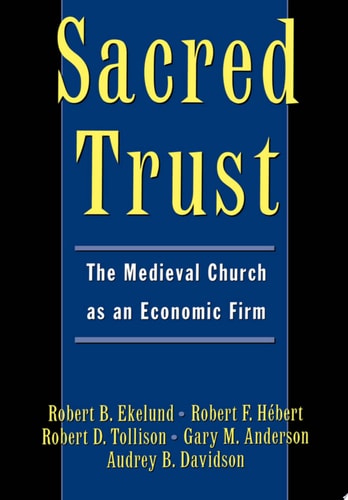
Sacred Trust: The Medieval Church as an Economic Firm
0
0
As an Amazon Associate and affiliate partner, Menrva Books earns from qualifying purchases. Learn more
Author Description
Without meaning to be irreverent, it is fair to say that in the Middle Ages, at the height of its political and economic power, the Roman Catholic Church functioned in part as a powerful and sophisticated corporation. The Church dealt in a "product" many consumers felt they had to have: the salvation of their immortal souls. The Pope served as its CEO, the College of Cardinals as its board of directors, bishoprics and monasteries as its franchises. And while the Church certainly had moral and social goals, this early antecedent to AT&T and General Motors had economic motives and methods as well, seeking to maximize profits by eliminating competitors and extending its markets.In Sacred Trust: The Medieval Church as an Economic Firm, five highly respected economists advance the controversial argument that the story of the Roman Catholic Church in the Middle Ages is in large part a story of supply and demand. Without denying the centrality--or sincerity--of religious motives, the authors employ the tools of modern economics to analyze how the Church's objectives went well beyond the realm of the spiritual. They explore the myriad sources of the Church's wealth, including tithes and land rents, donations and bequests, judicial services and monastic agricultural production. And they present an in-depth look at the ways in which Church principles on marriage, usury, and crusade were revised as necessary to meet--and in many ways to create--the needs of a vast body of consumers. Along the way, the book raises and answers many intriguing questions. The authors explore the reasons behind the great crusades against the Moslems, probing beyond motives of pure idealism to highlight the Church's concern with revenues from tourism and the sale of relics threatened by Moslem encroachment in the holy lands. They examine the Church's involvement in the marriage market, revealing how the clergy filled their coffers by extracting fees for blessing or dissolving marital unions, for hea
Menrva's Summary
THE THESIS
This book investigates the Roman Catholic Church during the Middle Ages as a sophisticated economic entity that operated with the strategic objectives of a modern corporation. The authors, a team of economists, apply modern economic theory to historical religious practices to argue that the Church functioned as a firm seeking to maximize revenue and market share. By analyzing the institutional structure of the papacy and its various administrative branches, the text provides a framework for understanding how spiritual services were managed through the lens of supply and demand.
THE SCOPE MAP
What You Will Find
- Analysis of the Church as a corporate hierarchy with the Pope as CEO and bishoprics as franchises
- Examination of revenue streams including tithes, land rents, judicial services, and the sale of relics
- Economic interpretation of religious policies regarding marriage, usury, and the Crusades
- Application of modern microeconomic principles to medieval institutional behavior
THE AUTHORITY PERSPECTIVE
Scholars and economists frequently cite this work for its provocative application of public choice theory to religious history. Readers often note the academic density of the prose, which requires a foundational understanding of economic terminology to fully grasp the authors' arguments.
Page Count:
224
Publication Date:
1996-10-31
Publisher:
Oxford University Press
ISBN-10:
0195103378
ISBN-13:
9780195103373
Economics
Religion
History
Corporate History
Community Tags
Similar Books







Reader Comments
Share Your Thoughts
No comments yet. Be the first to share your thoughts!