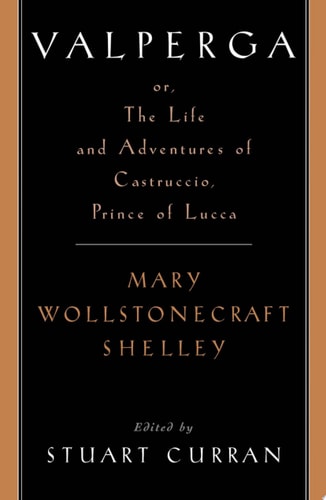
Valperga: Or, the Life and Adventures of Castruccio, Prince of Lucca
0
0
As an Amazon Associate and affiliate partner, Menrva Books earns from qualifying purchases. Learn more
Author Description
Valperga, published in 1823 and reprinted here for the first time, was Mary Shelley's second novel, the successor to Frankenstein. Set in fourteenth-century Tuscany, the novel shares certain structural features with the popular fictions of Sir Walter Scott, most notably the novel Ivanhoe with its contrasting heroines, but Mary Shelley's work pointedly challenges Scott's model, inverting his masculinist and conservative outlook, foregrounding the lives of its principal women, Euthanasia dei Adimari and Beatrice of Ferrara, and attaching to the figure of Castruccio Castracani, Prince of Lucca, a retrograde authoritarianism and sterile lust for power. Valperga, steeped in Mary Shelley's command of local Italian history and culture, offers the vivid pleasures of accomplished historical fiction while at the same time representing in the clash between Castruccio and Euthanasia a struggle between autocracy and liberal democracy that speaks directly to the contemporary political tensions of post-Napoleonic Europe. Timed for Mary Shelley's bicentennial and superbly introduced by Stuart Curran, this exciting new edition makes available a bold yet little-known work by one of the finest minds in English letters.
Menrva's Summary
THE PULSE
The central conflict arises from the ideological and personal collision between the ambitious, authoritarian Castruccio Castracani and the principled, democratic Euthanasia dei Adimari in fourteenth-century Tuscany. As Castruccio pursues his relentless quest for power and territorial dominance, he finds himself increasingly at odds with Euthanasia, a woman whose commitment to liberty and humanistic values stands in direct opposition to his militaristic expansion. The narrative explores the tension between individual agency and the crushing weight of political ambition within a volatile historical landscape. Shelley utilizes a complex, multi-perspective framework to examine the moral decay inherent in absolute rule and the resilience of those who resist it.
INSIDE THE PAGES
- Detailed reconstruction of fourteenth-century Italian political history
- Contrast between the archetypal heroines Euthanasia and Beatrice
- Exploration of the psychological toll of authoritarianism
- Subversion of the traditional historical novel tropes popularized by Sir Walter Scott
- Focus on the intersection of private morality and public power
- Use of the Italian landscape as a reflection of political instability
- Examination of the conflict between liberal democracy and autocracy
- Philosophical inquiry into the nature of power and sterile ambition
THE COLLECTIVE ECHO
Readers and critics frequently highlight the novel as a sophisticated critique of the power dynamics prevalent in post-Napoleonic Europe. Discussion often centers on how Shelley intentionally inverts the masculinist structures found in the works of her contemporaries to center the experiences of her female protagonists. The pacing is noted for its deliberate, intellectual approach, favoring thematic depth over rapid action sequences. Many observers appreciate the meticulous historical research that grounds the narrative, noting that the book serves as a vital counterpoint to the more widely read works of the period. The text is widely recognized for its ability to weave complex political theory into a compelling, character-driven narrative structure.
Page Count:
480
Publication Date:
1998-01-08
Publisher:
Oxford University Press
ISBN-10:
0195108825
ISBN-13:
9780195108828
Romance
Historical Fiction
Political fiction
Classic Literature
19th Century
Community Tags
Similar Books