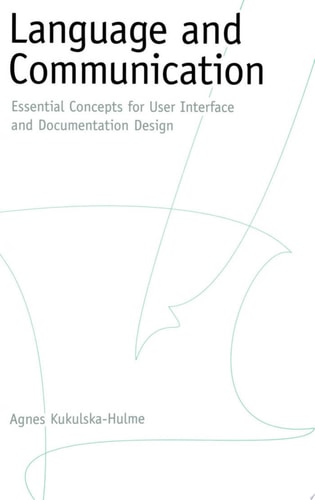
Language and Communication: Essential Concepts for User Interface and Documentation Design
0
0
As an Amazon Associate and affiliate partner, Menrva Books earns from qualifying purchases. Learn more
Author Description
Computer interfaces and documentation are notoriously difficult for any user, regardless of his or her level of experience. Advances in technology are not making applications more friendly. Introducing concepts from linguistics and language teaching, Language and Communication proposes a new approach to computer interface design. The book explains for the first time why the much hyped user-friendly interface is treated with such derision by the user community. The author argues that software and hardware designers should consider such fundamental language concepts as meaning, context, function, variety, and equivalence. She goes on to show how imagining an interface as a new language can be an invaluable design exercise, calling into question deeply held beliefs and assumptions about what users will or will not understand. Written for a wide range of computer scientists and professionals, and presuming no prior knowledge of language-related terminology, this volume is a key step in the on-going information revolution.
Menrva's Summary
THE THESIS
This book investigates the persistent failure of computer interfaces and documentation to achieve true user-friendliness by applying linguistic theory to the design process. Agnes Kukulska-Hulme, an expert in language learning and technology, argues that the disconnect between designers and users stems from a misunderstanding of how language functions in human-computer interaction. By framing the interface as a new language, the author provides a framework for designers to re-evaluate their assumptions about meaning, context, and functional equivalence in software development.
THE SCOPE MAP
What You Will Find
- Linguistic concepts applied to software and hardware design
- Analysis of user frustration regarding interface usability
- Methodologies for treating interfaces as communicative languages
- Practical considerations for meaning, context, function, and variety in design
THE AUTHORITY PERSPECTIVE
Experts recognize this work as a foundational text for bridging the gap between linguistic theory and practical software engineering. Professionals frequently cite the book for its accessible introduction to complex communication concepts, making it a standard reference for those seeking to improve user-centered design outcomes.
Page Count:
176
Publication Date:
1999-04-01
Publisher:
Oxford University Press
ISBN-10:
0195108388
ISBN-13:
9780195108385
Technical Writing
Technology
Linguistics
Communication
Computer Interfaces
Community Tags
Similar Books