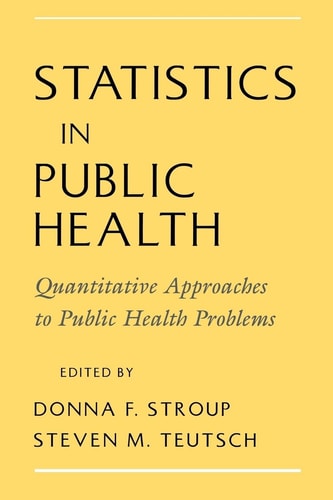
Statistics in Public Health: Quantitative Approaches to Public Health Problems
0
0
As an Amazon Associate and affiliate partner, Menrva Books earns from qualifying purchases. Learn more
Author Description
Public health strives to improve the health of human populations, and prevent disease, disability, and death. Statistics--the science of finding underlying patterns by analyzing variability and errors in collected data--is essential to the understanding of disease patterns in human populations. Other quantitative methods, such as economics, decision theory, and mathematics, now constitute integral parts of the scientific basis for priority-setting and evaluation in public health.This book provides a broad conceptual treatment of the statistical issues underlying core public health functions: outbreak investigations, policy development, economic and program evaluation, managed care, and program operations. The theoretical analysis is illustrated with examples from public health practice. For readers interested in a more detailed treatment, there are extensive references to specialized publications.The authors present a series of quantitative approaches that significantly help public health professionals solve the problems they confront in their day-to-day work. Unlike traditional how-to books in statistics, this volume starts with an overview of the range of problems encountered in public health practice, and then presents methods for facilitating decision making. Statistics in Public Health: Quantitative Approaches to Public Health Problems will serve as a comprehensive desk reference for public health practitioners and as a teaching text for students of public health.
Menrva's Summary
THE THESIS
This book investigates how statistical and quantitative methodologies serve as the foundational framework for addressing complex public health challenges and informing policy decisions. Donna F. Stroup and Steven M. Teutsch leverage their extensive experience in public health practice to bridge the gap between theoretical statistical analysis and real-world application. The authors argue that by integrating economics, decision theory, and mathematics, practitioners can more effectively evaluate programs, manage care, and respond to disease outbreaks. The text provides a conceptual overview designed to assist professionals in navigating the variability and errors inherent in population-level data.
THE SCOPE MAP
What You Will Find
- Statistical frameworks for outbreak investigations and disease pattern analysis
- Methodologies for economic evaluation and program assessment in public health
- Quantitative approaches to policy development and priority-setting
- Case studies illustrating the application of decision theory in managed care settings
THE AUTHORITY PERSPECTIVE
Experts identify this work as a practical desk reference that successfully moves beyond traditional, formula-heavy statistics textbooks to focus on decision-making utility. Readers frequently note that the text provides a clear, conceptual bridge between abstract mathematical theory and the daily operational requirements of public health professionals.
Page Count:
256
Publication Date:
1998-07-15
Publisher:
Oxford University Press
ISBN-10:
0195114981
ISBN-13:
9780195114980
Mathematics
Health Surveys
Data Analysis
Statistics
Epidemiology
Public Health
Community Tags
Similar Books