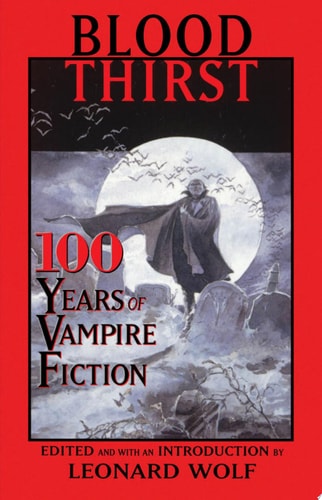
Blood Thirst: 100 Years of Vampire Fiction
0
0
As an Amazon Associate and affiliate partner, Menrva Books earns from qualifying purchases. Learn more
Author Description
In the past hundred years, since the publication of Bram Stoker's infamous book, no literary figure has enjoyed a more horrific resiliency than Count Dracula. In film, television, novels, and short stories, he keeps coming back to life, fed by the vital imaginative energies of a world-wide audience that cannot seem to resist his abominable charms. Aristocratic and urbane, deeply erotic and profoundly evil, Dracula's bloodsucking savagery has cast a mesmerizing fascination not only over his victims but over his readers as well. And, as Leonard Wolf suggests, "Vampire fiction...exerts an amazing pull on readers for a reason that we may find disturbing. The blood exchange--the taking of blood by the vampire from his or her victim is, all by itself, felt to be a singularly symbolic event. Symbolic and attractive!"Now, in Blood Thirst: One Hundred Years of Vampire Fiction, Leonard Wolf brings together thirty tales in which vampires of all varieties make their ghastly presence felt--male and female, human and non-human, humorous and heroic--all of them kin to the dreadful bat. From Lafcadio Hearn, Mary E. Wilkins-Freeman, Edith Wharton, August Derleth, and Ray Bradbury to such contemporary masters as Anne Rice, Stephen King, Joyce Carol Oates, John Cheever, and Woody Allen, and in settings as diverse as rural New England and outer space, this collection offers readers a dazzling compendium of vampire stories. Wolf organizes the collection into six categories--The Classic Adventure Tale, The Psychic Vampire, The Science Fiction Vampire, The Non-Human Vampire, The Comic Vampire, and The Heroic Vampire--which allows readers to see the many guises Dracula's descendants have assumed and the many ways they can be interpreted. In his penetrating introduction, Wolf argues that such an arrangement enables us to see the evolution of the vampire from an unmitigated evil to a creature we are more likely to identify with.
Menrva's Summary
THE PULSE
This collection examines the enduring cultural fascination with the vampire archetype through a curated selection of short fiction spanning a century. The anthology presents a diverse array of narratives that explore the evolution of the vampire from a symbol of pure malice to a complex, often sympathetic figure. By organizing these stories into thematic categories, the editor provides a structural framework that highlights how different authors utilize the vampire to reflect changing societal anxieties and literary trends. The collection functions as a comprehensive overview of the genre's versatility, moving from traditional gothic settings to contemporary and experimental environments.
INSIDE THE PAGES
- Inclusion of classic gothic tales from early 20th-century authors.
- Exploration of the 'psychic vampire' as a metaphor for emotional predation.
- Integration of science fiction elements to modernize the traditional mythos.
- Inclusion of humorous and satirical takes on the vampire trope.
- Examination of the 'heroic' vampire archetype in contemporary literature.
- Diverse geographical and temporal settings ranging from rural New England to outer space.
- Critical introduction providing historical context for the evolution of the vampire.
- Broad range of literary styles from classic horror to modern psychological fiction.
THE COLLECTIVE ECHO
Readers frequently highlight the impressive breadth of this anthology, noting that it successfully captures the transformation of the vampire figure over the last century. Discussion often centers on the editor's thematic categorization, which many find helpful for understanding the various sub-genres within vampire fiction. Critics appreciate the inclusion of both canonical authors and lesser-known writers, providing a well-rounded perspective on the genre's development. The balance between traditional horror and more experimental, modern interpretations is often cited as a primary strength of the collection. Readers find the introductory essays provide valuable insight into the symbolic nature of the vampire, making the collection accessible to both casual fans and serious students of horror literature.
Page Count:
384
Publication Date:
1997-10-09
Publisher:
Oxford University Press
ISBN-10:
0195115937
ISBN-13:
9780195115932
Horror
Short Stories
Vampire
Anthology
Gothic
Community Tags
Similar Books