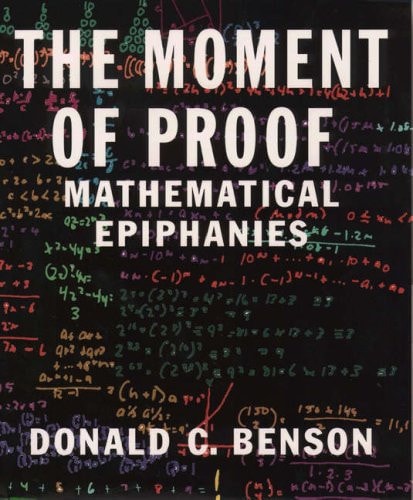
The Moment of Proof: Mathematical Epiphanies
0
0
As an Amazon Associate and affiliate partner, Menrva Books earns from qualifying purchases. Learn more
Author Description
When Archimedes, while bathing, suddenly hit upon the principle of buoyancy, he ran wildly through the streets of Syracuse, stark naked, crying "eureka!" In The Moment of Proof, Donald Benson attempts to convey to general readers the feeling of eureka--the joy of discovery--that mathematicians feel when they first encounter an elegant proof.This is not an introduction to mathematics so much as an introduction to the pleasures of mathematical thinking. And indeed the delights of this book are many and varied. The book is packed with intriguing conundrums--Loyd's Fifteen Puzzle, the Petersburg Paradox, the Chaos Game, the Monty Hall Problem, the Prisoners' Dilemma--as well as many mathematical curiosities. We learn how to perform the arithmetical proof called "casting out nines" and are introduced to Russian peasant multiplication, a bizarre way to multiply numbers that actually works. The book shows us how to calculate the number of ways a chef can combine ten or fewer spices to flavor his soup (1,024) and how many people we would have to gather in a room to have a 50-50 chance of two having the same birthday (23 people). But most important, Benson takes us step by step through these many mathematical wonders, so that we arrive at the solution much the way a working scientist would--and with much the same feeling of surprise.Every fan of mathematical puzzles will be enthralled by The Moment of Proof. Indeed, anyone interested in mathematics or in scientific discovery in general will want to own this book.
Menrva's Summary
THE THESIS
This book investigates the nature of mathematical discovery and the specific cognitive satisfaction, or 'eureka' moment, experienced by mathematicians when encountering elegant proofs. Donald C. Benson, drawing on his background in mathematical exposition, curates a collection of classic problems and curiosities to bridge the gap between abstract theory and intuitive understanding. By guiding the reader through step-by-step logical processes, the author demonstrates that mathematical thinking is a accessible, pleasurable pursuit rather than a purely academic exercise. The text serves as an invitation to experience the surprise and clarity inherent in solving complex numerical challenges.
THE SCOPE MAP
What You Will Find
- Analysis of classic mathematical conundrums including the Monty Hall Problem and the Prisoners' Dilemma.
- Practical demonstrations of arithmetic techniques like 'casting out nines' and Russian peasant multiplication.
- Explorations of probability theory through real-world scenarios such as the birthday paradox.
- Step-by-step logical frameworks designed to replicate the experience of scientific discovery.
THE AUTHORITY PERSPECTIVE
Readers frequently note that the book successfully demystifies complex concepts for a general audience without sacrificing intellectual rigor. Experts highlight this as a highly accessible entry point for those interested in the aesthetic and logical beauty of mathematical problem-solving.
Page Count:
352
Publication Date:
1999-03-25
Publisher:
Oxford University Press
ISBN-10:
0195117212
ISBN-13:
9780195117219
Science
Non-Fiction
Education
Mathematics
Puzzles
Popular Works
Community Tags
Similar Books