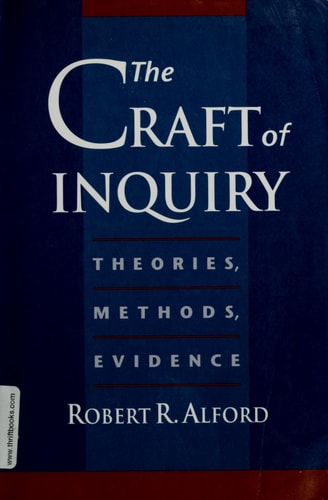
The Craft of Inquiry: Theories, Methods, Evidence
0
0
As an Amazon Associate and affiliate partner, Menrva Books earns from qualifying purchases. Learn more
Author Description
Sociology is a challenging discipline, ripe with exciting possibilities. It offers sociologists the chance to choose multiple theoretical and methodological traditions that offer a full range of important questions and ways to answer them. A long standing complaint of many sociology professors, however, is that their students seem to have difficulty moving from problem formation to a theoretical approach and then onto an appropriate research design.In his provocative new book, Robert Alford proposes that the starting point for any researcher in the process and craft of inquiry should begin with an understanding of how to translate elements of his/her own history, personal experience, and issues, which can then be formulated into research questions. Alford presents three basic explanatory approaches to sociology -- multivariate, interpretive, and historical -- as well as examples of each from such luminaries as Durkheim, Goffman, Weber, Marx, and William Julius Wilson. Upon critical examination, Alford finds each of these three approaches either oversimplified or incomplete. To fill this gap, Alford proposes a tripartite approach that examines each approach through the lens of the other two and analyzes the ways these three models of explanation work and relate to one another. The text is intended to show students how research emerges from, and interacts with, theory. It is designed to help students formulate, reformulate, and pursue their own theoretically informed research, as well as provide them with the tools necessary for critically reading the research of others. Using selected examples from both classic and contemporary studies, Alford strives to illustrate the artistic, rather than formulaic, side of research design and presents several ways that research questions can be framed. He also offers a "working vocabulary" to guide novice researchers through the maze of the process. Full of direct, lucid, and informative accounts of actual research efforts, The Craft of Inquiry is a valuable resource for students and scholars alike.
Menrva's Summary
THE THESIS
How can researchers effectively bridge the gap between personal inquiry, theoretical frameworks, and rigorous research design? Robert R. Alford, a seasoned sociologist, addresses the common struggle students face when transitioning from abstract problem formation to concrete methodology. He argues that research is an artistic process rather than a rigid formula, proposing a tripartite model that integrates multivariate, interpretive, and historical approaches to provide a more comprehensive understanding of social phenomena.
THE SCOPE MAP
What You Will Find
- A comparative analysis of multivariate, interpretive, and historical explanatory models.
- A framework for translating personal experience and history into formal research questions.
- Case studies and critiques of foundational work by theorists such as Durkheim, Goffman, Weber, and Marx.
- A specialized working vocabulary designed to assist novice researchers in navigating the complexities of inquiry.
THE AUTHORITY PERSPECTIVE
Experts and educators frequently cite this text as a foundational resource for graduate-level sociology students learning to synthesize theory with empirical design. Readers often note the academic density of the prose, which is balanced by Alford's practical, step-by-step guidance on the craft of research.
Page Count:
176
Publication Date:
1998-03-05
Publisher:
Oxford University Press
ISBN-10:
0195119037
ISBN-13:
9780195119039
Theory
Social Science
Sociology
Research Methods
Academic writing
Community Tags
Similar Books