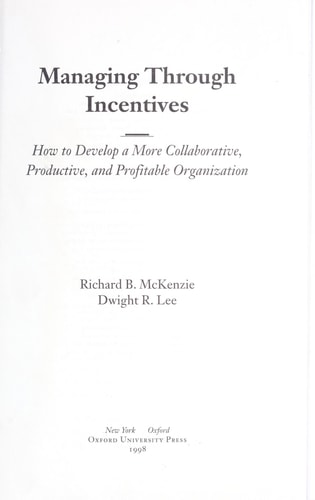
Managing Through Incentives: How to Develop a More Collaborative, Productive and Profitable Organization
0
0
As an Amazon Associate and affiliate partner, Menrva Books earns from qualifying purchases. Learn more
Author Description
Incentives are the most powerful tools executives can use to improve worker performance. This is particularly true in today's empowered workplace, where incentives can ensure that workers apply their initiative toward company goals. Now, in this groundbreaking book, Richard McKenzie and Dwight Lee show how to select the right incentives and how to use them for best results.Generously illustrated with examples from business, industry, government, academia, and professional sports, this superb volume offers a comprehensive overview of incentives, both in theory and in practice, providing a wealth of ideas managers can use to get employees to work harder, smarter, and more cooperatively. Much of the book is quite eye-opening. For instance, while McKenzie and Lee recognize that money is the prime motivator, they urge managers not to overlook the power of non-monetary incentives, carefully evaluating such motivators as fringe benefits, psychological incentives, education, and training. And they examine a host of other issues, including how to take advantage of executive "overpayment" to increase profits; the limits of piece-rate and other pay-for-performance schemes; finding the right balance between current pay and a more generous pension plan; the value of tough bosses; and hostile takeovers as a form of managerial incentive.How workers are rewarded is often more important than how much they are rewarded, say the authors. The job of good managers is getting the incentives right. Managing Through Incentives shows managers how to apply proven motivators to help any size firm energize the work force, increase its profits, and meet the awesome challenges of today's fiercely competitive global economy.
Menrva's Summary
THE THESIS
This book investigates how organizational leaders can utilize strategic incentive structures to align individual employee performance with broader corporate objectives. Authors Dwight R. Lee and Richard B. McKenzie, both established economists, leverage principles of behavioral economics and organizational theory to argue that the design of reward systems is often more critical to productivity than the absolute value of compensation. They provide a framework for managers to evaluate both monetary and non-monetary motivators to foster a more efficient and profitable workplace environment.
THE SCOPE MAP
What You Will Find
- Analysis of monetary versus non-monetary incentive structures including fringe benefits and psychological motivators.
- Evaluation of pay-for-performance schemes and the limitations of piece-rate compensation models.
- Case studies drawn from diverse sectors such as professional sports, government, academia, and private industry.
- Examination of complex managerial topics including executive compensation, pension planning, and the role of hostile takeovers.
THE AUTHORITY PERSPECTIVE
Experts recognize this work as a practical application of economic theory to the challenges of modern human resource management. Readers frequently note that the prose is accessible to business professionals while maintaining a rigorous focus on the underlying mechanics of organizational behavior.
Page Count:
352
Publication Date:
1998-09-24
Publisher:
Oxford University Press
ISBN-10:
0195119010
ISBN-13:
9780195119015
Economics
Business
Leadership
Management
Human Resources
Employee motivation
Community Tags
Similar Books