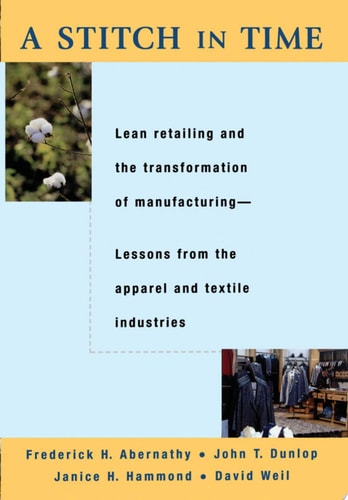
A Stitch in Time: Lean Retailing and the Transformation of Manufacturing--Lessons from the Apparel and Textile Industries
0
0
As an Amazon Associate and affiliate partner, Menrva Books earns from qualifying purchases. Learn more
Author Description
The apparel and textile industries have always been at the mercy of rapidly changing styles and fickle customers who want the latest designs while they are still in fashion. The result for these businesses, often forced to forecast sales and order from suppliers with scant information about volatile demand, is a history of stock shortages, high inventories, and costly markdowns. But, as the authors explain in A Stitch in Time, technological advances in the 1980s paved the way for a new concept in retailing--lean retailing.Pioneered by companies like WAL-MART, lean retailing has reshaped the way that products are ordered, virtually eliminating delays from distribution center to sales rack by drawing on sales data captured electronically at the checkout counter. Armed with up-to-the-minute data about colors, sizes, styles, and geographic sales, apparel and textile companies now must be able to respond rapidly to real-time orders efficiently based on new approaches to distributing merchandise, forecasting, planning, organizing production, and managing supplier relations. A Stitch in Time shows that even in the face of burgeoning product proliferation, companies that successfully adapt to the world of lean retailing can reduce inventory risk, reduce costs, and increase profitability while improving their responsiveness to the ever-changing tastes of customers. Based on the success of these practices in the apparel industry, lean retailing practices are propagating through a growing number of consumer product industries.A richly detailed and resonant account, A Stitch in Time brilliantly captures both the history and future of the retail-apparel-textile channel and offers bold insights on the changes and challenges facing retailers and manufacturers in all segments of our rapidly changing economy.
Menrva's Summary
THE THESIS
This book investigates how the adoption of lean retailing practices transformed the operational efficiency and profitability of the apparel and textile industries. The authors, a team of researchers including David Weil and John T. Dunlop, utilize extensive industry data and historical analysis to argue that real-time data integration between retailers and manufacturers is essential for mitigating demand volatility. They present a framework for understanding how electronic point-of-sale data allows firms to move away from speculative forecasting toward responsive, demand-driven production models.
THE SCOPE MAP
What You Will Find
- Analysis of the shift from traditional forecasting to real-time lean retailing models.
- Examination of the role of electronic data capture at the point of sale in supply chain optimization.
- Case studies focusing on the apparel and textile sectors, including the influence of major retailers like Wal-Mart.
- Strategies for managing supplier relations, production planning, and inventory risk in a high-proliferation product environment.
THE AUTHORITY PERSPECTIVE
Experts recognize this work as a foundational text for understanding the evolution of modern supply chain management and retail logistics. Readers frequently note the academic rigor and the clarity with which the authors connect historical industry shifts to broader economic principles.
Page Count:
384
Publication Date:
1999-07-29
Publisher:
Oxford University Press
ISBN-10:
0195126157
ISBN-13:
9780195126150
Economics
Business
Clothing trade
Retail
Manufacturing
Manufactures
Textile industry
Community Tags
Similar Books









Reader Comments
Share Your Thoughts
No comments yet. Be the first to share your thoughts!