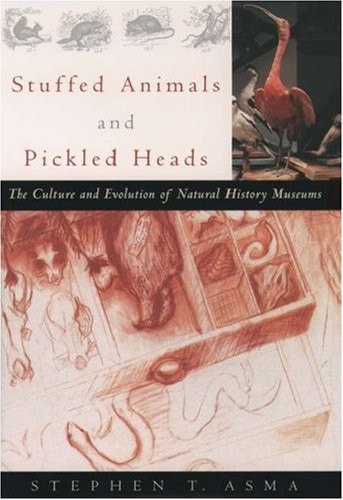
Stuffed Animals and Pickled Heads: The Culture of Natural History Museums
0
0
As an Amazon Associate and affiliate partner, Menrva Books earns from qualifying purchases. Learn more
Author Description
The natural history museum is a place where the line between "high" and "low" culture effectively vanishes--where our awe of nature, our taste for the bizarre, and our thirst for knowledge all blend happily together. But as Stephen Asma shows in Stuffed Animals and Pickled Heads, there is more going on in these great institutions than just smart fun.Asma takes us on a wide-ranging tour of natural history museums in New York and Chicago, London and Paris, interviewing curators, scientists, and exhibit designers, and providing a wealth of fascinating observations. We learn how the first museums were little more than high-toned side shows, with such garish exhibits as the pickled head of Peter the Great's lover. In contrast, today's museums are hot-beds of serious science, funding major research in such fields as anthropology and archaeology. Asma also points out that these museums actively shape our perception of nature, and that these efforts are swayed as much by politics as by science. In countless exhibits, for instance, the idea of the traditional nuclear family is evident in displays of everything from extinct animals to grizzly bears (in nature, alas, the male bear is more likely to devour its young than to nurture them).Where else but at a natural history museum could you find a T. rex, a high-tech planetarium, a Native American totem pole, and flesh-eating beetles--all under one roof. And in Stuffed Animals and Pickled Heads, Stephen Asma reveals that what we don't see--the scientific research that is going on backstage--is just as fascinating as the exhibits on display.
Menrva's Summary
THE THESIS
How do natural history museums function as both centers of scientific research and cultural mirrors that shape our perception of the natural world? Stephen T. Asma, a professor of philosophy, investigates the evolution of these institutions from their origins as eclectic cabinets of curiosities to their current status as rigorous research facilities. By analyzing the intersection of public display, political influence, and scientific inquiry, Asma argues that museums are not neutral repositories of facts but are active participants in constructing societal narratives about nature and family structures.
THE SCOPE MAP
What You Will Find
- Historical evolution of museum collections from side-show curiosities to academic research centers.
- Analysis of how exhibit design reflects contemporary political and social ideologies.
- Interviews with curators, scientists, and exhibit designers from major institutions in New York, Chicago, London, and Paris.
- Examination of the tension between public entertainment and serious scientific research.
THE AUTHORITY PERSPECTIVE
Critics and readers frequently praise the book for its accessible prose and its ability to blend historical anecdote with philosophical inquiry. Scholars often highlight this work as a valuable contribution to the field of museum studies, noting its success in exposing the subjective nature of institutional displays.
Page Count:
320
Publication Date:
2001-04-05
Publisher:
Oxford University Press
ISBN-10:
0195130502
ISBN-13:
9780195130508
Non-Fiction
Science
History
Natural History
Culture
Anthropology
Museum Studies
Community Tags
Similar Books