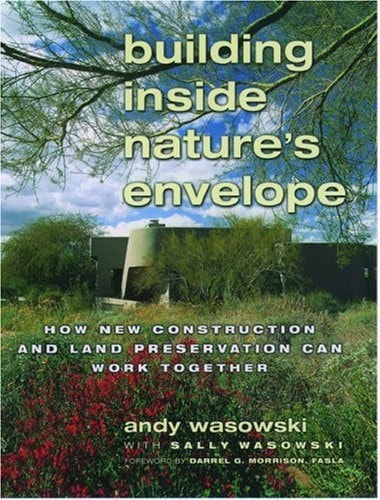
Building Inside Nature's Envelope: How New Construction and Land Preservation Can Work Together
0
0
As an Amazon Associate and affiliate partner, Menrva Books earns from qualifying purchases. Learn more
Author Description
Every year, many thousands of acres of woodlands, deserts, meadowlands, and coastal scrub are turned into home or commercial sites. Ironically, by the time these structures are complete, bulldozers have scraped the land clean of its natural vegetation and character, much of which attracted buyers in the first place. In Building Inside Nature's Envelope, Andy Wasowski introduces a new and exciting technique for salvaging the natural land upon which we build new homes, new offices, or even new shopping centers.Wasowski argues that the unnatural landscapes so common in America literally exist on artificial life support. A natural landscape, on the other hand, is filled with native flora and can exist on rainfall alone. It is, as one builder said, akin to stepping lightly on the earth. To help builders and prospective home owners achieve this "light step," the author introduces the idea of the Envelope, an approach to construction that is cost effective, simple, and environmentally responsible. A structure built within nature's envelope looks as if it has been gently set down into a mature and established landscape--which is the easiest kind of landscape to maintain. He illustrates this new concept in construction through profiles of sites in California, Arizona, South Carolina, Minnesota, and other locales in North America. He also highlights useful techniques for revegetation, discusses the importance of soils, and argues for the preservation and maintenance of natural habitats.Attractively illustrated with 88 pictures--including 41 full-color images--Building Inside Nature's Envelope offers a practical blueprint for creating a community where both wildlife and human life thrive in a harmonious relationship.
Menrva's Summary
THE THESIS
How can modern construction practices be adapted to preserve existing natural ecosystems rather than destroying them during development? Andy Wasowski, an expert in native landscaping, argues that the prevailing model of clearing land for construction is ecologically and economically inefficient. He proposes the 'Envelope' method, a framework that integrates new structures into established natural environments to minimize disruption and reduce the need for artificial maintenance like irrigation or chemical fertilizers.
THE SCOPE MAP
What You Will Find
- Case studies of construction projects in diverse North American climates including California, Arizona, and Minnesota.
- Practical methodologies for site assessment and the protection of native flora during the building process.
- Technical advice on soil health and the long-term maintenance of natural habitats.
- Strategies for revegetation and the integration of native plant species into commercial and residential design.
THE AUTHORITY PERSPECTIVE
Professionals in sustainable architecture and landscape design frequently cite this work as a practical manual for developers seeking to reduce environmental impact. Experts highlight the book's accessible approach to complex ecological concepts, making it a useful resource for both builders and homeowners interested in conservation-minded construction.
Page Count:
176
Publication Date:
2000-12-14
Publisher:
Oxford University Press
ISBN-10:
0195131762
ISBN-13:
9780195131765
Architecture
Construction
Sustainability
Landscape architecture
Landscaping
Community Tags
Similar Books