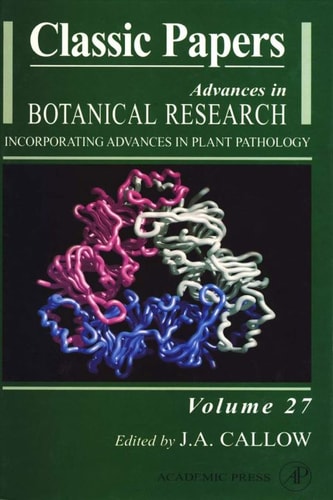
Classic Papers: Advances in Botanical Research, Volume 27
0
0
As an Amazon Associate and affiliate partner, Menrva Books earns from qualifying purchases. Learn more
Author Description
Articles in this Classic Papers volume are rewritten, up-dated and extended versions of papers published in previous volumes of Advances in Botanical Research, chosen because of the high citation of the original papers and the increase of knowledge in the field today. Boulter and Croy discuss the structure and biosynthesis of legume seed storage proteins, an area that has been revolutionized in recent years by advances in 3-D structural analysis and methods of gene manipulation. Raven writes about the significant progress made in our understanding of the biochemistry of inorganic carbon acquisition by marine autotrophs, and places this new information in evolutionary and biogeochemical contexts. Advances in biochemistry have also made impact on research into cyanotixons. Carmichael considers the expansion of cyanotoxin research in the light of the negative impact of these toxins on water quality and aquaculture industries. The structure and regulation of algal photosystems are discussed by Larkum and Howe. They write about the diversity of algal photochemical apparatus and light-harvesting strategy, which has only been appreciated with the use of molecular genetic approaches. Finally, Kunze, Saedler and Loonig review advances in the field of plant transposable elements and the mechanism of transposition. They cover the role of transposable elements in evolution and their use as molecular tools, the importance of which has only speculated on in the original paper in 1986.
Menrva's Summary
THE THESIS
This volume investigates the evolution of key botanical research topics by revisiting and updating highly cited papers from previous editions of the series to reflect contemporary scientific advancements. Editor J. A. Callow compiles contributions from various experts who synthesize decades of progress in plant science. The text serves as a bridge between foundational discoveries and modern methodologies, specifically focusing on how new analytical tools have transformed our understanding of plant biochemistry and genetics.
THE SCOPE MAP
What You Will Find
- Analysis of legume seed storage protein structure and biosynthesis.
- Examination of inorganic carbon acquisition in marine autotrophs.
- Review of cyanotoxin research and its implications for water quality.
- Discussion on the regulation and diversity of algal photosystems.
- Overview of plant transposable elements and their evolutionary significance.
Scope Limits
- The text does not provide a comprehensive history of all botanical research, focusing only on selected high-citation topics.
- It does not serve as an introductory textbook for beginners, assuming prior knowledge of plant biology.
THE AUTHORITY PERSPECTIVE
Researchers and academics frequently utilize this volume as a retrospective reference to track the trajectory of specific botanical subfields. Experts highlight the text as a valuable resource for understanding how molecular genetic approaches have refined earlier biological theories.
Page Count:
515
Publication Date:
1997-07-22
Publisher:
Academic Press
ISBN-10:
0120059274
ISBN-13:
9780120059270
Science
Botany
Biological Sciences & Nutrition - Biology - Botany
Plant Biology
Power Resources
Biochemistry
Ecology
General
Community Tags
Similar Books