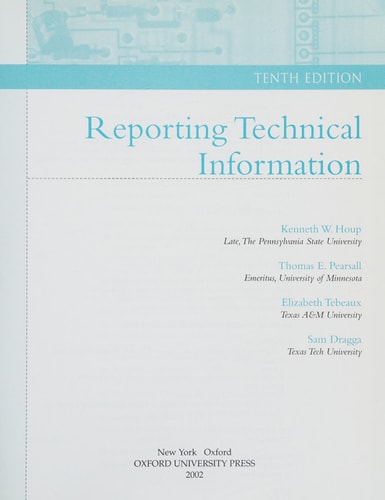
Reporting Technical Information
0
0
As an Amazon Associate and affiliate partner, Menrva Books earns from qualifying purchases. Learn more
Author Description
The leading text in technical writing, Reporting Technical Information introduces students to all aspects of technical communication, including letters, proposals and progress reports, recommendation reports, research reports, instructions, and oral reports. Continuing the esteemed tradition of its predecessors, the tenth edition provides students with a solid foundation in technical communication and adds material on the most recent developments in the field.Through accessible language, challenging exercises, and realistic examples, Reporting Technical Information, 10/e, begins with the basic strategies of composing and writing, progresses to techniques of technical communication, and closes by applying those techniques to document creation and design. Documentation instructions include Chicago and APA styles, as well as a guide for citing the Internet as a source. The book also offers detailed coverage of the latest technology in electronic communication, including material on writing collaboratively via e-mail, synchronous discussions, and FTP sites.The tenth edition features four new chapters:* Chapter 6, Writing Ethically, provides realistic exercises dealing with ethical dilemmas, guides students to relevant Web sites, and includes illustrative material from the codes of various professional groups.* Chapter 7, Writing for International Readers, offers a concise yet comprehensive introduction to the differences among world cultures and the effects of these differences on communication. It covers such issues as the importance of personal relationships, individualism versus collectivism, various views of truth, and the power and value of time.* Chapter 8, Gathering, Evaluating, and Documenting Information, helps students formulate research questions and points them to several sources of information including interviewing, the electronic library catalog, indexes, and the Internet.* Information on empirical research reports is now broken out into a separate chapte
Menrva's Summary
THE THESIS
This text investigates the foundational principles and evolving methodologies required for effective technical communication in professional environments. The authors, Elizabeth Tebeaux, Sam Dragga, Kenneth W. Houp, and Thomas E. Pearsall, synthesize decades of pedagogical experience to provide a comprehensive framework for document creation, research, and ethical practice. By integrating traditional writing strategies with modern electronic communication tools, the book establishes a structured approach to producing clear, accurate, and audience-appropriate technical documentation.
THE SCOPE MAP
What You Will Find
- Comprehensive guides for drafting letters, proposals, progress reports, and recommendation reports.
- Methodologies for conducting empirical research and documenting sources using Chicago and APA styles.
- Frameworks for addressing ethical dilemmas and cross-cultural communication challenges in global business.
- Technical instructions for collaborative writing via electronic platforms and digital networks.
THE AUTHORITY PERSPECTIVE
Experts recognize this work as a foundational textbook for university-level technical communication courses. Readers frequently note the balance between theoretical instruction and practical, exercise-based application in the prose.
Page Count:
720
Publication Date:
2001-08-23
Publisher:
Oxford University Press
ISBN-10:
0195146123
ISBN-13:
9780195146127
Communication
Technical Reports
Professional Development
Education
Reference
Technical Writing
Community Tags
Similar Books





Reader Comments
Share Your Thoughts
No comments yet. Be the first to share your thoughts!