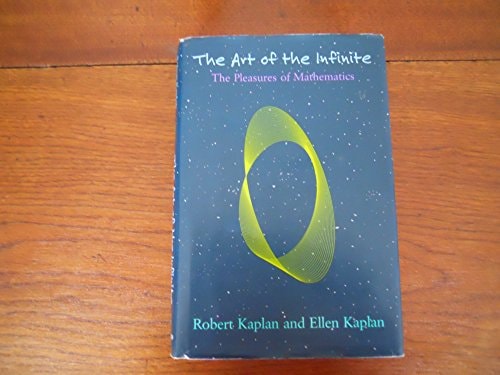
The Art of the Infinite: The Pleasures of Mathematics
0
0
As an Amazon Associate and affiliate partner, Menrva Books earns from qualifying purchases. Learn more
Author Description
Robert Kaplan's The Nothing That Is: A Natural History of Zero was an international best-seller, translated into eight languages. The Times called it "elegant, discursive, and littered with quotes and allusions from Aquinas via Gershwin to Woolf" and The Philadelphia Inquirer praised it as "absolutely scintillating."In this delightful new book, Robert Kaplan, writing together with his wife Ellen Kaplan, once again takes us on a witty, literate, and accessible tour of the world of mathematics. Where The Nothing That Is looked at math through the lens of zero, The Art of the Infinite takes infinity, in its countless guises, as a touchstone for understanding mathematical thinking. Tracing a path from Pythagoras, whose great Theorem led inexorably to a discovery that his followers tried in vain to keep secret (the existence of irrational numbers); through Descartes and Leibniz; to the brilliant, haunted Georg Cantor, who proved that infinity can come in different sizes, the Kaplans show how the attempt to grasp the ungraspable embodies the essence of mathematics. The Kaplans guide us through the "Republic of Numbers," where we meet both its upstanding citizens and more shadowy dwellers; and we travel across the plane of geometry into the unlikely realm where parallel lines meet. Along the way, deft character studies of great mathematicians (and equally colorful lesser ones) illustrate the opposed yet intertwined modes of mathematical thinking: the intutionist notion that we discover mathematical truth as it exists, and the formalist belief that math is true because we invent consistent rules for it."Less than All," wrote William Blake, "cannot satisfy Man." The Art of the Infinite shows us some of the ways that Man has grappled with All, and reveals mathematics as one of the most exhilarating expressions of the human imagination.
Menrva's Summary
THE THESIS
How does the human mind conceptualize and quantify the infinite through the evolution of mathematical thought? The authors, Robert and Ellen Kaplan, utilize their expertise in mathematics and history to examine how the pursuit of infinity has shaped logical frameworks. They argue that mathematics is not merely a collection of rigid rules, but a creative expression of the human imagination that bridges the gap between intuition and formal structure.
THE SCOPE MAP
What You Will Find
- Historical progression of mathematical concepts from Pythagoras to Georg Cantor.
- Analysis of the tension between intuitionist and formalist mathematical philosophies.
- Biographical sketches of influential and lesser-known mathematicians.
- Exploration of irrational numbers, geometry, and the varying sizes of infinity.
THE AUTHORITY PERSPECTIVE
Critics and readers frequently praise the text for its accessible, literary prose that avoids overly technical jargon while maintaining intellectual rigor. Experts highlight this work as a successful bridge between the history of ideas and pure mathematics, suitable for both laypeople and those with a casual interest in the field.
Page Count:
336
Publication Date:
2003-04-03
Publisher:
Oxford University Press
ISBN-10:
019514743X
ISBN-13:
9780195147438
Non-Fiction
Science
Mathematics
Popular Works
Community Tags
Similar Books