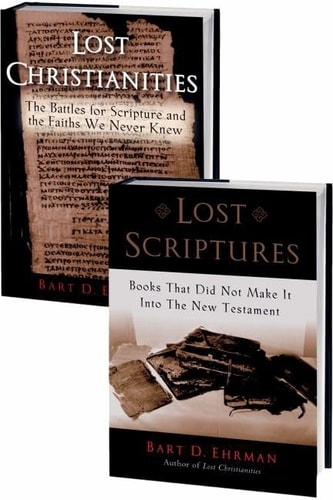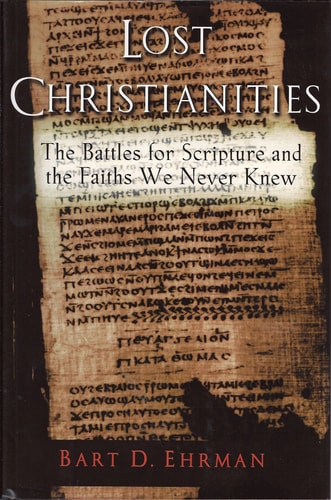
The Lost Christianities: The Battles for Scripture and the Faiths We Never Knew
0
0
As an Amazon Associate and affiliate partner, Menrva Books earns from qualifying purchases. Learn more
Author Description
The early Christian Church was a chaos of contending beliefs. Some groups of Christians claimed that there was not one God but two or twelve or thirty. Some believed that the world had not been created by God but by a lesser, ignorant deity. Certain sects maintained that Jesus was human but not divine, while others said he was divine but not human.In Lost Christianities, Bart D. Ehrman offers a fascinating look at these early forms of Christianity and shows how they came to be suppressed, reformed, or forgotten. All of these groups insisted that they upheld the teachings of Jesus and his apostles, and they all possessed writings that bore out their claims, books reputedly produced by Jesus's own followers. Modern archaeological work has recovered a number of key texts, and as Ehrman shows, these spectacular discoveries reveal religious diversity that says much about the ways in which history gets written by the winners. Ehrman's discussion ranges from considerations of various "lost scriptures"--including forged gospels supposedly written by Simon Peter, Jesus's closest disciple, and Judas Thomas, Jesus's alleged twin brother--to the disparate beliefs of such groups as the Jewish-Christian Ebionites, the anti-Jewish Marcionites, and various "Gnostic" sects. Ehrman examines in depth the battles that raged between "proto-orthodox Christians"-- those who eventually compiled the canonical books of the New Testament and standardized Christian belief--and the groups they denounced as heretics and ultimately overcame.Scrupulously researched and lucidly written, Lost Christianities is an eye-opening account of politics, power, and the clash of ideas among Christians in the decades before one group came to see its views prevail.
Menrva's Summary
THE THESIS
How did one specific branch of early Christianity emerge as the dominant orthodoxy while others were suppressed or forgotten? Bart D. Ehrman, a prominent scholar of early Christian history, utilizes archaeological evidence and textual analysis to examine the diverse, competing belief systems that existed before the standardization of the New Testament. He argues that the eventual triumph of proto-orthodox Christianity was not an inevitable outcome of superior truth, but rather the result of complex political and social power struggles within the early church.
THE SCOPE MAP
What You Will Find
- Analysis of non-canonical texts such as the Gospel of Peter and the Gospel of Thomas.
- Examination of diverse theological sects including Gnostics, Marcionites, and Ebionites.
- Historical investigation into the process of canonization and the suppression of alternative scriptures.
- Evaluation of the political and social mechanisms used by proto-orthodox leaders to define heresy.
THE AUTHORITY PERSPECTIVE
Scholars and readers frequently cite this work as a foundational text for understanding the diversity of early Christian thought. The prose is noted for its accessibility, making complex historical and theological debates understandable for non-specialist audiences.
Page Count:
320
Publication Date:
2003-10-02
Publisher:
Oxford University Press
ISBN-10:
0195141830
ISBN-13:
9780195141832
History
Non-Fiction
Religion
Christianity
Theology
Bible_criticism Interpretation Etc_n T Apocryphal Books
Community Tags
Similar Books