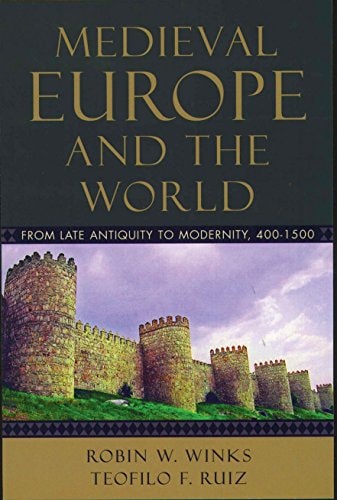
Medieval Europe and the World: From Late Antiquity to Modernity, 400-1500 [Large Print]
0
0
As an Amazon Associate and affiliate partner, Menrva Books earns from qualifying purchases. Learn more
Author Description
Medieval Europe and the World: From Late Antiquity to Modernity, 400-1500 examines the development of western European social, political, economic, and cultural institutions during one of the most complex and creative periods the world has ever known. The book looks at the history of Medieval Europe in relation to its links with the rest of the world, exploring the interaction of western Europe with Islam, the Far East, Africa, and such outlying areas as Scandinavia, Iberia, and Eastern Europe. It considers the genesis and shaping of distinct western ideals, social affairs, economic patterns, and new cultural forms in relation to Islam and Byzantium--two other great civilizations that deeply influenced the growth of western Europe's unique history. Placing emphasis on medieval Europe's social and economic transformations and the diversity of social orders, the book analyzes the ways in which these elements interconnected during the formation of medieval society. It also gives special consideration to the twelfth and thirteenth centuries, an era that serves as a bridge between the cultural developments of the early and central Middle Ages and the emergence of new patterns of thought and social organization in the late medieval period.Featuring nine maps, numerous illustrations, a chronological table, and a detailed list of suggested further readings, this brief but comprehensive narrative is an ideal text for undergraduate courses in medieval history.
Menrva's Summary
THE THESIS
This text investigates how western European social, political, and cultural institutions evolved between 400 and 1500 through constant interaction with global civilizations. Teofilo F. Ruiz and the late Robin W. Winks utilize a comparative historical framework to challenge the notion of Europe as an isolated entity. By examining trade, conflict, and cultural exchange with Islam, Byzantium, and other regions, the authors argue that the formation of the western identity was fundamentally shaped by external influences and interconnected global networks.
THE SCOPE MAP
What You Will Find
- Analysis of social, economic, and political transformations from Late Antiquity to the late medieval period.
- Comparative studies of European interactions with Islamic, Far Eastern, and African civilizations.
- Examination of the twelfth and thirteenth centuries as a transitional bridge for social and intellectual development.
- Pedagogical support materials including nine maps, illustrations, chronological tables, and bibliographies for further research.
THE AUTHORITY PERSPECTIVE
Experts and educators identify this work as a foundational text for undergraduate medieval history curricula due to its balanced, concise narrative. Readers frequently note the clarity of the prose and the effectiveness of the global perspective in contextualizing European development within a broader historical framework.
Page Count:
320
Publication Date:
2005-02-17
Publisher:
Oxford University Press
ISBN-10:
0195156943
ISBN-13:
9780195156942
History
Middle Ages
World history
European History
Academic
Community Tags
Similar Books