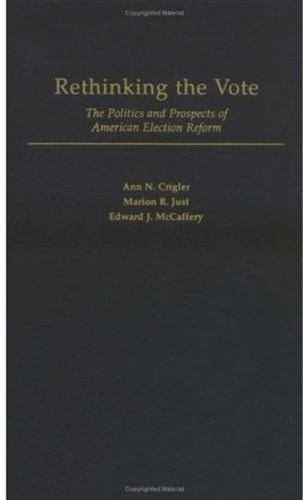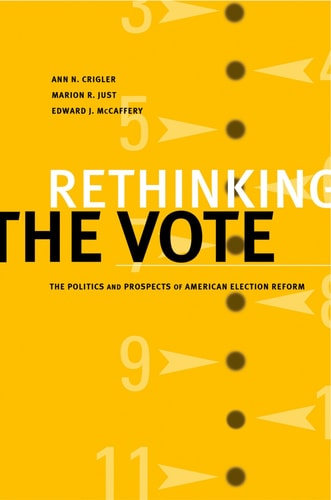
Rethinking the Vote: The Politics and Prospects of American Election Reform
0
0
As an Amazon Associate and affiliate partner, Menrva Books earns from qualifying purchases. Learn more
Author Description
Maintaining the perception of fairness and equal access during elections assures the legitimacy of a democratic system. The U.S. in particular prides itself on its open and honest voting laws and procedures. However, the extraordinary closeness of the 2000 presidential election between George W. Bush and Al Gore triggered a rare scrutiny of the election process. This highly disputed contest revealed problems with ballot design and order; access to the polls; voting machines; absentee, military, and overseas ballots; election laws and the Electoral College; and judicial oversight of the voting process. It brought to light issues regarding political polling in general, exit polls in particular, media projections and reporting, and even the election night "calling" of outcomes.Rethinking the Vote: The Politics and Prospects of American Election Reform centers on what can and should be learned about the processes of voting. Using the 2000 presidential election as a starting point, this collection of essays puts forth a constructive effort to learn from what transpired and to offer potential solutions for the future. Featuring work by leading academics and participants in the real-world drama of the 2000 election, it examines the legal, political, and institutional problems of administering elections in the U.S. The book begins and ends with questions about the prospects and possibilities for reform. It takes a consistently pragmatic approach that recognizes both the constraints on and the opportunities for change in America's elaborate constitutional and political structures. Providing a useful mix of quantitative and qualitative data, Rethinking the Vote is ideal for undergraduate courses in American politics, American elections, public opinion and voting behavior, American political thought, campaigns and elections, presidential politics, and media and politics.
Menrva's Summary
THE THESIS
This book investigates the systemic vulnerabilities of the American electoral process exposed by the 2000 presidential election and evaluates the feasibility of institutional reform. Ann N. Crigler, a scholar in political communication and public opinion, compiles a series of essays from academic experts and political practitioners to analyze the intersection of law, technology, and media in voting. The text argues that while the U.S. political structure presents significant constitutional constraints, pragmatic adjustments to election administration are necessary to maintain democratic legitimacy. By synthesizing diverse perspectives, the work provides a framework for understanding how ballot design, judicial oversight, and media reporting influence public perception and electoral outcomes.
THE SCOPE MAP
What You Will Find
- Analysis of the 2000 presidential election as a case study for systemic failure.
- Examination of technical and administrative issues including ballot design, voting machines, and absentee ballot procedures.
- Evaluation of the role of media projections, exit polling, and election night reporting on voter behavior.
- Discussion of legal and institutional barriers to reform within the American constitutional framework.
THE AUTHORITY PERSPECTIVE
Experts and educators frequently cite this collection as a foundational text for undergraduate courses in American politics and election administration. Readers note that the prose maintains an academic tone while offering a balanced, pragmatic assessment of the complexities inherent in U.S. voting systems.
Page Count:
288
Publication Date:
2003-08-07
Publisher:
Oxford University Press
ISBN-10:
0195159853
ISBN-13:
9780195159851
Politics
History
Election law
United States
Elections
Government
Community Tags
Similar Books