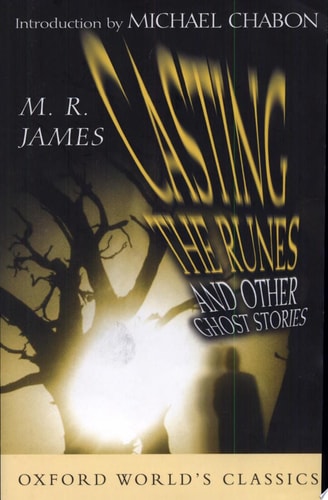
Casting the Runes: And Other Ghost Stories
0
0
As an Amazon Associate and affiliate partner, Menrva Books earns from qualifying purchases. Learn more
Author Description
When we think of ghost stories, we tend to think of cub scouts cringing by a fire, s'mores at the ready, as some aging camp counselor tries to scare them witless with yet another tale from the crypt. But as Michael Chabon's marvelous introduction reminds us, the ghost story was once integral to the genre of the short story. Indeed, as he points out, it can be argued that the ghost story was the genre. Dickens's "A Christmas Carol," Henry James's "The Turn of the Screw"--most of the early short story writers wrote ghost stories as a matter of course. And the best writer of ghost stories, the acknowledged master, was M.R. James.In Casting the Runes, we have twenty-one tales that, in Chabon's words, "venture to the limits of the human capacity for terror and revulsion...armed only with an umbrella and a very dry wit." The stories here represent the best of James's work. They are set in the leisurely, late-Victorian, middle-class world of country houses, seaside inns, out-of-the-way railway stations, and cathedral closes, where gentlemen of independent means and antiquarian tastes suddenly find themselves confronted by terrifying agents of supernatural malice. But what these tales are really about, writes Chabon, "is ultimately the breathtaking fragility of life, of 'reality,' of all the structures that we have erected to defend ourselves from our constant nagging suspicion that underlying everything is chaos, brutal and unreasoning."The tales in Casting the Runes are both chilling fun and, as Chabon concludes, "unmistakably works of art." Anyone who loves short fiction or who enjoys a good scare will find these stories an irresistible delight.
Menrva's Summary
THE PULSE
Antiquarian scholars and gentlemen of leisure find their orderly lives shattered when they inadvertently disturb ancient, malevolent forces. These stories follow protagonists who, while pursuing academic or personal interests in remote settings, encounter supernatural entities that defy rational explanation. The narrative framework typically utilizes a detached, scholarly tone that contrasts sharply with the encroaching horror. As the characters attempt to apply logic to these encounters, they are forced to confront the fragility of their own reality. The tension builds through the slow accumulation of unsettling details rather than overt action, highlighting the vulnerability of the human condition against an unreasoning, chaotic universe.
INSIDE THE PAGES
- Atmospheric settings including isolated country houses and cathedral closes
- Scholarly protagonists with antiquarian interests
- Gradual escalation of supernatural dread
- Dry, understated wit characteristic of the Edwardian era
- Focus on the intrusion of the uncanny into mundane life
- Use of ancient artifacts and cursed objects as catalysts
- Precise, descriptive prose that emphasizes environmental detail
- Exploration of the thin boundary between reality and chaos
THE COLLECTIVE ECHO
Readers and critics frequently highlight M.R. James as the definitive architect of the modern ghost story. Discussion often centers on his ability to blend academic precision with genuine, creeping terror that avoids reliance on cheap shocks. Critics note that the pacing is deliberate, allowing the atmosphere of the late-Victorian setting to fully immerse the reader before the supernatural elements manifest. Many appreciate the intellectual rigor of the protagonists, which makes their eventual descent into fear more impactful. The collection is widely regarded as a foundational text for those interested in the evolution of short fiction and the mechanics of psychological horror.
Page Count:
320
Publication Date:
2002-09-05
Publisher:
Oxford University Press
ISBN-10:
0195151178
ISBN-13:
9780195151176
Horror
Classic Literature
Supernatural
Short Stories
Gothic
Ghost Stories
Community Tags
Similar Books