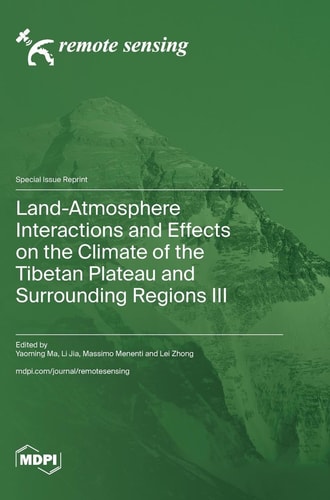
Land-Atmosphere Interactions and Effects on the Climate of the Tibetan Plateau and Surrounding Regions III
0
0
As an Amazon Associate and affiliate partner, Menrva Books earns from qualifying purchases. Learn more
Author Description
As the world's highest and most expansive plateau, the Tibetan Plateau (TP) is often hailed as the 'Asian Water Tower' and the 'Third Pole of the Earth'. Gaining a deeper insight into the water and energy cycles within the TP is crucial, not only for uncovering the dynamics of regional land-atmosphere interactions but also for evaluating the factors influencing alterations in the cryosphere and hydrosphere, in connection with atmospheric changes over the plateau within the Asian monsoon framework. Given that the TP is an ecologically delicate area that is highly responsive to climate variations, a systematic analysis of the land-atmosphere interactions here is instrumental in fostering a quantitative comprehension of climate change. This Special Issue showcases the latest progress in the quantitative analyses of the various factors related to land-atmosphere interactions, including surface heat fluxes, atmospheric boundary layer characteristics, soil moisture, precipitation, cloud, thunderstorm, radiation, and albedo over the Tibetan Plateau, along with their unique climate effects on surrounding regions. The selected contributions are both innovative and timely, enriching our understanding of land-atmosphere interactions propelled by global warming. We are confident that this compilation of research will serve as a valuable quantitative resource for enhancing the assessment and forecasting of land-atmosphere interactions in the 'Third Pole'.
Menrva's Summary
THE THESIS
This collection investigates the intricate relationship between land and atmosphere on the Tibetan Plateau and its impact on regional climate. The Tibetan Plateau, a critical region known as the 'Asian Water Tower' and the 'Third Pole,' plays a vital role in global climate dynamics. Understanding its water and energy cycles is essential for comprehending regional land-atmosphere interactions, cryosphere and hydrosphere changes, and atmospheric alterations within the Asian monsoon framework. This special issue presents recent advancements in quantitatively analyzing factors such as surface heat fluxes, atmospheric boundary layer characteristics, soil moisture, precipitation, cloud cover, thunderstorms, radiation, and albedo, and their unique climate effects on surrounding regions.
THE SCOPE MAP
- Quantitative analyses of surface heat fluxes and atmospheric boundary layer characteristics over the Tibetan Plateau.
- Studies on soil moisture, precipitation, cloud, thunderstorm, radiation, and albedo dynamics.
- Assessment of the unique climate effects of land-atmosphere interactions on surrounding regions.
- Research on the connection between land-atmosphere interactions and changes in the cryosphere and hydrosphere.
- Exploration of the influence of these interactions within the Asian monsoon framework.
- Contributions focusing on the impact of global warming on land-atmosphere interactions in this sensitive region.
THE AUTHORITY PERSPECTIVE
This compilation of research showcases the latest progress in the quantitative analysis of land-atmosphere interactions on the Tibetan Plateau. The selected contributions are noted for being both innovative and timely, aiming to enrich the understanding of these processes, particularly in the context of global warming. The work is presented as a valuable quantitative resource for enhancing the assessment and forecasting of land-atmosphere interactions in the 'Third Pole' region. The collection is expected to foster a deeper, quantitative comprehension of climate change in this ecologically delicate area.
Page Count:
320
Publication Date:
2025-03-07
Publisher:
Mdpi AG
ISBN-10:
3725833710
ISBN-13:
9783725833719
Science
Science & Technology
Non-Fiction
Geography
Climate Change
Community Tags
Similar Books