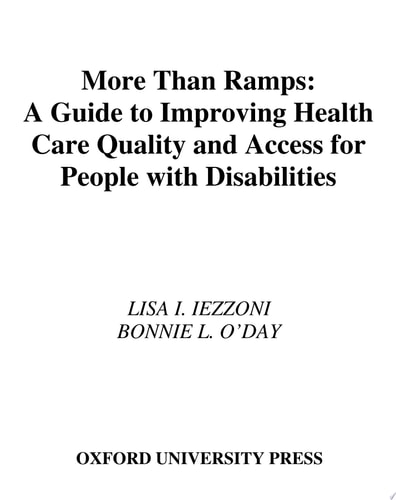
More than Ramps: A Guide to Improving Health Care Quality and Access for People with Disabilities
0
0
As an Amazon Associate and affiliate partner, Menrva Books earns from qualifying purchases. Learn more
Author Description
Nearly twenty percent of Americans live today with some sort of disability, and this number will grow in coming decades as the population ages. Despite this, the U.S. health care system is not set up to provide care comfortably, safely, and efficiently to persons with disabilities. Individuals with disabilities can therefore face significant barriers to obtaining high quality health care. Some barriers result from obvious impediments, such as doors without automatic openers and examining tables that are too high. Other barriers arise from faulty communication between patients and health care professionals, including misconceptions among clinicians about the daily lives, preferences, values, and abilities of persons with disabilities. Yet additional barriers relate to health insurance limits on items and services essential to maximizing health and independence. This book examines the health care experiences of persons who are blind, deaf, hard of hearing, or who have difficulties using their legs, arms, or hands. The book then outlines strategies for overcoming or circumventing barriers to care, starting by just asking persons with disabilities about workable solutions. Creating safe and accessible health care for persons with disabilities will likely benefit everyone at some point. This book has three parts. The first part looks at the historical roots of healthcare access for persons with disabilities in the United States. The second part discusses the current situation and the special challenges for those with disabilities. The third part looks forward to discuss the ways in which healthcare quality and access can improve.
Menrva's Summary
THE THESIS
How can the United States health care system be restructured to provide equitable, safe, and efficient access for individuals with disabilities? Bonnie L. O'Day and Lisa I. Iezzoni, both experts in disability policy and health services research, analyze the systemic failures that prevent quality care for this demographic. They argue that barriers extend far beyond physical infrastructure, encompassing communication gaps, clinician bias, and restrictive insurance policies. The authors propose a framework centered on patient-led solutions and systemic reform to ensure health equity for all.
THE SCOPE MAP
What You Will Find
- Historical analysis of disability access within the U.S. medical system
- Identification of physical, communicative, and insurance-based barriers to care
- Strategies for clinicians to improve patient-provider interactions
- Policy recommendations for maximizing health and independence for persons with disabilities
THE AUTHORITY PERSPECTIVE
Experts recognize this work as a foundational text for understanding the intersection of disability rights and health care delivery. Readers frequently note the clarity of the authors' arguments and the practical utility of the proposed solutions for medical professionals and policy makers.
Page Count:
384
Publication Date:
2005-12-15
Publisher:
Oxford University Press
ISBN-10:
0195172760
ISBN-13:
9780195172768
Health insurance
Health Care
Medicine
Sociology
Medical care
Public Policy
Services For
Community Tags
Similar Books