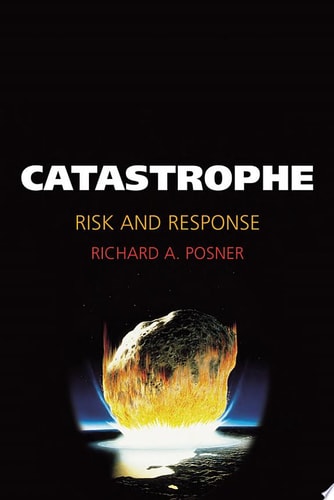
Catastrophe: Risk and Response
0
0
As an Amazon Associate and affiliate partner, Menrva Books earns from qualifying purchases. Learn more
Author Description
Catastrophes, whether natural or man-made, that could destroy the human race are often dismissed as alarmist or fanciful, the stuff of science fiction. In fact the risk of such disasters is real, and growing. A collision with an asteroid that might kill a quarter of humanity in 24 hours and the rest soon after; irreversible global warming that might flip, precipitating "snowball earth;" voraciously replicating nanomachines; a catastrophic accident in a particle accelerator that might reduce the earth to a hyperdense sphere 100 meters across; a pandemic of gene-spliced smallpox launched by bioterrorists; even conquest by superintelligent robots-all these potential extinction events, and others, are within the realm of the possible and warrant serious thought about assessment and prevention. They are attracting the concern of reputable scientists--but not of the general public or the nation's policymakers.How should the nation and the world respond to disaster possibilities that, for a variety of psychological and cultural reasons, people find it hard to wrap their minds around? Richard Posner shows that what is needed is a fresh, thoroughly interdisciplinary perspective that will meld the insights of lawyers, economists, psychologists, and other social scientists with those of the physical sciences. Responsibility for averting catastrophe cannot be left either to scientists or to politicians and other policymakers ignorant of science.As in many of his previous books, Posner brings law and the social sciences to bear on a contemporary problem-in this case one of particular urgency. Weighing the risk and the possible responses in each case, Posner shows us what to worry about and what to dismiss, and discusses concrete ways of minimizing the most dangerous risks. Must we yield a degree of national sovereignty in order to deal effectively with global warming? Are limitations on our civil liberties a necessary and proper response to the danger of bioterror attacks? Would
Menrva's Summary
THE THESIS
This book investigates the urgent need for a systematic, interdisciplinary framework to assess and mitigate low-probability, high-consequence events that threaten human extinction. Richard A. Posner, a prominent jurist and legal scholar, synthesizes insights from law, economics, psychology, and the physical sciences to address the gap between scientific concern and public policy. He argues that current political and social structures are ill-equipped to handle existential risks, necessitating a more rigorous, evidence-based approach to global security and environmental management.
THE SCOPE MAP
What You Will Find
- Analysis of existential threats including asteroid impacts, climate change, nanotechnology, and bioterrorism.
- A framework for evaluating the cost-benefit trade-offs of preventative measures versus civil liberty restrictions.
- Examination of the psychological and cultural biases that prevent policymakers from addressing long-term, catastrophic risks.
- Proposals for international cooperation and the potential necessity of yielding national sovereignty to manage global environmental crises.
THE AUTHORITY PERSPECTIVE
Experts and reviewers frequently note the book's analytical rigor and its unique application of legal and economic theory to scientific catastrophe scenarios. Readers often highlight the text's provocative stance on balancing security measures with individual rights, making it a significant contribution to the discourse on global risk management.
Page Count:
336
Publication Date:
2004-11-11
Publisher:
Oxford University Press
ISBN-10:
0195178130
ISBN-13:
9780195178135
Science
Politics
Philosophy
Non-Fiction
Philosophy history
Disasters
Sociology
Environment
Professional Career & Trade
Community Tags
Similar Books