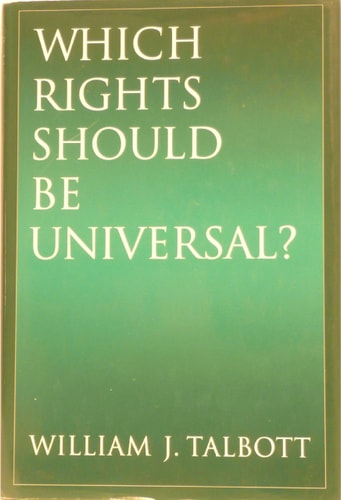
Which Rights Should Be Universal?
Author Description
"We hold these truths to be self-evident..." So begins the U.S. Declaration of Independence. What follows those words is a ringing endorsement of universal rights, but it is far from self-evident. Why did the authors claim that it was? William Talbott suggests that they were trapped by a presupposition of Enlightenment philosophy: That there was only one way to rationally justify universal truths, by proving them from self-evident premises.With the benefit of hindsight, it is clear that the authors of the U.S. Declaration had no infallible source of moral truth. For example, many of the authors of the Declaration of Independence endorsed slavery. The wrongness of slavery was not self-evident; it was a moral discovery.In this book, William Talbott builds on the work of John Rawls, Jürgen Habermas, J.S. Mill, Amartya Sen, and Henry Shue to explain how, over the course of history, human beings have learned how to adopt a distinctively moral point of view from which it is possible to make universal, though not infallible, judgments of right and wrong. He explains how this distinctively moral point of view has led to the discovery of the moral importance of nine basic rights.Undoubtedly, the most controversial issue raised by the claim of universal rights is the issue of moral relativism. How can the advocate of universal rights avoid being a moral imperialist? In this book, Talbott shows how to defend basic individual rights from a universal moral point of view that is neither imperialistic nor relativistic. Talbott avoids moral imperialism by insisting that all of us, himself included, have moral blindspots and that we usually depend on others to help us to identify those blindspots.Talbott's book speaks to not only debates on human rights but to broader issues of moral and cultural relativism, and will interest a broad range of readers.
Menrva's Summary
THE THESIS
This book investigates the foundational question of how universal human rights can be rationally justified without relying on self-evident premises or falling into the traps of moral relativism or imperialism. William J. Talbott, a scholar of moral and political philosophy, critiques the Enlightenment-era reliance on self-evident truths by examining historical moral progress. He constructs a framework that treats moral judgments as fallible discoveries rather than absolute axioms, drawing upon the intellectual traditions of John Rawls, Jürgen Habermas, and Amartya Sen to argue for a distinctively moral point of view.
THE SCOPE MAP
What You Will Find
- A historical analysis of how human societies have identified and adopted a moral point of view over time.
- A philosophical defense of nine specific basic rights derived from a non-imperialistic, universal perspective.
- A methodology for identifying moral blindspots through collaborative discourse and external critique.
- An exploration of the tension between universalism and cultural relativism in modern human rights debates.
THE AUTHORITY PERSPECTIVE
Scholars and students of political philosophy frequently cite this work as a rigorous attempt to reconcile universalist ethics with the realities of moral fallibility. Experts highlight the text as a significant contribution to the ongoing discourse regarding human rights and the limitations of Enlightenment rationalism.
Page Count:
232
Publication Date:
2005-03-17
Publisher:
Oxford University Press
ISBN-10:
0195173473
ISBN-13:
9780195173475
Philosophy
Human rights
Ethics
Social Science
Community Tags
Similar Books