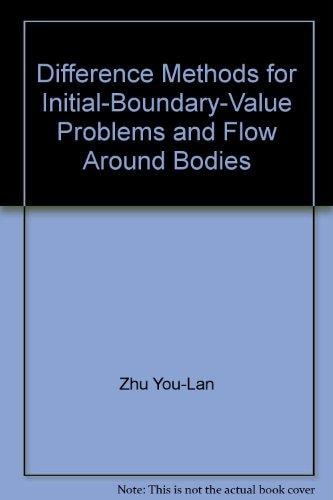
Difference Methods for Initial-Boundary-Value Problems and Flow Around Bodies
0
0
As an Amazon Associate and affiliate partner, Menrva Books earns from qualifying purchases. Learn more
Author Description
Since the appearance of computers, numerical methods for discontinuous solutions of quasi-linear hyperbolic systems of partial differential equations have been among the most important research subjects in numerical analysis. The authors have developed a new difference method (named the singularity-separating method) for quasi-linear hyperbolic systems of partial differential equations. Its most important feature is that it possesses a high accuracy even for problems with singularities such as schocks, contact discontinuities, rarefaction waves and detonations. Besides the thorough description of the method itself, its mathematical foundation (stability-convergence theory of difference schemes for initial-boundary-value hyperbolic problems) and its application to supersonic flow around bodies are discussed. Further, the method of lines and its application to blunt body problems and conical flow problems are described in detail. This book should soon be an important working basis for both graduate students and researchers in the field of partial differential equations as well as in mathematical physics.
Menrva's Summary
THE THESIS
This book introduces a novel singularity-separating difference method for solving quasi-linear hyperbolic systems of partial differential equations, particularly those with discontinuities. The authors, Zhu You-Lan, present a method designed for high accuracy in problems involving shocks, contact discontinuities, rarefaction waves, and detonations. The work details the mathematical underpinnings, including the stability-convergence theory for initial-boundary-value hyperbolic problems, and demonstrates its application to supersonic flow around bodies. Additionally, the book explores the method of lines and its use in blunt body and conical flow problems.
THE SCOPE MAP
- Development of the singularity-separating difference method for quasi-linear hyperbolic systems.
- High-accuracy solutions for problems with singularities like shocks and detonations.
- Mathematical foundation: stability-convergence theory for hyperbolic initial-boundary-value problems.
- Application to supersonic flow around bodies.
- Detailed discussion of the method of lines.
- Application of the method of lines to blunt body problems.
- Application of the method of lines to conical flow problems.
THE AUTHORITY PERSPECTIVE
The book is presented as a significant contribution to numerical analysis, particularly for researchers and graduate students working with partial differential equations and mathematical physics. Its focus on handling discontinuities with high accuracy suggests it aims to be a practical and theoretical resource for complex fluid dynamics problems. The detailed treatment of both the method and its applications indicates a comprehensive approach to the subject matter. The authors' development of a new method implies a forward-looking perspective on computational techniques.
Page Count:
600
Publication Date:
1988-01-01
Publisher:
Springer-Verlag
ISBN-10:
3540108874
ISBN-13:
9783540108870
Non-Fiction
Science
Mathematical Physics
Numerical analysis
Community Tags
Similar Books