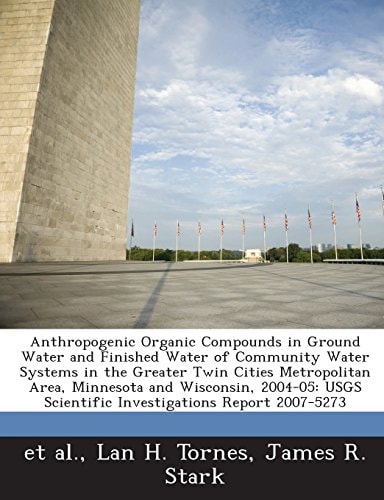
Anthropogenic Organic Compounds in Ground Water and Finished Water of Community Water Systems in the Greater Twin Cities Metropolitan Area, Minnesota
0
0
As an Amazon Associate and affiliate partner, Menrva Books earns from qualifying purchases. Learn more
Author Description
As part of the U.S. Geological Survey's National Water-Quality Assessment (NAWQA) Program, two Source Water-Quality Assessments (SWQAs) were conducted during 2004-05 in unconfined parts of the glacial aquifer system and in unconfined parts of the Prairie du Chien-Jordan aquifer in the Greater Twin Cities metropolitan area of Minnesota and Wisconsin. SWQAs are two-phased sampling activities in the NAWQA Program. The first phase evaluated the occurrence of 265 (258 are included in this report) anthropogenic organic compounds (AOCs) through monitoring source water in 30 of the largest-producing community water system wells completed in the aquifers underlying the Greater Twin Cities metropolitan area. The AOCs included volatile organic compounds (VOCs), pesticides, and other AOCs. During the second phase of the study, 15 of the original community water system wells, those with the greatest number of AOC detections, were resampled along with associated finished water.
Menrva's Summary
THE THESIS
This report investigates the presence and extent of anthropogenic organic compounds in groundwater and finished water sources within the Greater Twin Cities metropolitan area. The study, conducted as part of the U.S. Geological Survey's National Water-Quality Assessment (NAWQA) Program, monitored 30 community water system wells completed in unconfined glacial and Prairie du Chien-Jordan aquifers. The research focused on identifying 265 (258 reported) organic compounds, including volatile organic compounds (VOCs) and pesticides, in the source water. A second phase re-sampled 15 wells with the highest detection rates, examining both source and finished water to understand potential contamination pathways and impacts.
THE SCOPE MAP
- Occurrence of 265 anthropogenic organic compounds (AOCs) in groundwater.
- Identification of specific AOCs including volatile organic compounds (VOCs) and pesticides.
- Monitoring of source water in 30 community water system wells.
- Analysis of finished water from 15 selected wells.
- Data from two Source Water-Quality Assessments (SWQAs) conducted in 2004-05.
- Focus on unconfined parts of the glacial aquifer system and the Prairie du Chien-Jordan aquifer.
- Geographic scope: Greater Twin Cities metropolitan area of Minnesota and Wisconsin.
THE AUTHORITY PERSPECTIVE
This technical report provides a detailed scientific assessment of organic compound contamination in a critical metropolitan water supply. The methodology, employing the U.S. Geological Survey's NAWQA program framework, suggests a rigorous approach to data collection and analysis. The findings are likely to be of significant interest to environmental scientists, water resource managers, and public health officials concerned with groundwater quality in urbanized regions.
Page Count:
60
Publication Date:
2011-09-04
Publisher:
BiblioGov
ISBN-10:
1243598832
ISBN-13:
9781243598837
Non-Fiction
Science
Water Quality
Pollution
Groundwater
Community Tags
Similar Books