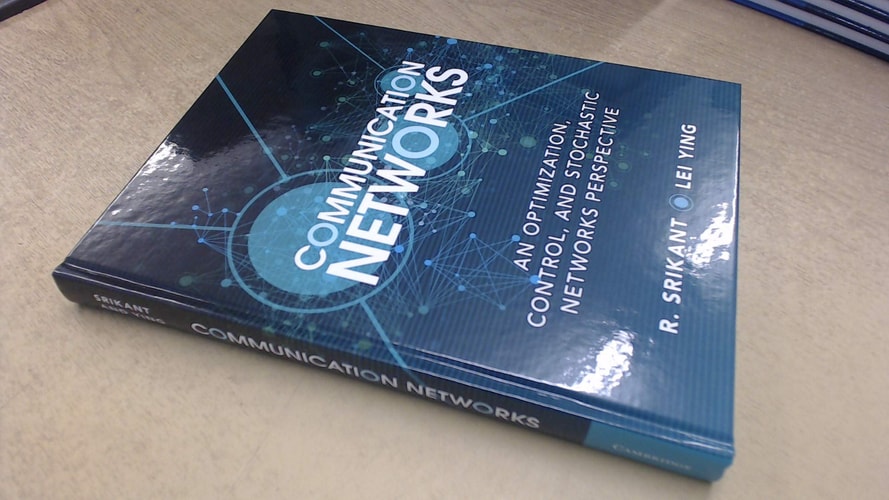
Communication Networks: An Optimization, Control and Stochastic Networks Perspective
0
0
As an Amazon Associate and affiliate partner, Menrva Books earns from qualifying purchases. Learn more
Author Description
Provides a modern mathematical approach to the design of communication networks for graduate students, blending control, optimization, and stochastic network theories. A broad range of performance analysis tools are discussed, including important advanced topics that have been made accessible to students for the first time. Taking a top-down approach to network protocol design, the authors begin with the deterministic model and progress to more sophisticated models. Network algorithms and protocols are tied closely to the theory, illustrating the practical engineering applications of each topic. The background behind the mathematical analyses is given before the formal proofs and is supported by worked examples, enabling students to understand the big picture before going into the detailed theory. End-of-chapter problems cover a range of difficulties, with complex problems broken into several parts, and hints to many problems are provided to guide students. Full solutions are available online for instructors.
Menrva's Summary
THE THESIS
This book presents a modern mathematical framework for designing communication networks by integrating control, optimization, and stochastic network theories. The authors, Lei Ying and R. Srikant, leverage their expertise to guide graduate students through complex concepts, starting with deterministic models and progressing to more advanced stochastic and control-based approaches. The text emphasizes the practical application of theoretical concepts by closely linking network algorithms and protocols to their underlying mathematical principles. It provides a thorough grounding in the mathematical background before formal proofs, supported by worked examples to ensure comprehension.
THE SCOPE MAP
- A comprehensive overview of performance analysis tools for communication networks.
- Discussion of advanced topics in network design, made accessible for the first time.
- A top-down approach to network protocol design, moving from deterministic to sophisticated models.
- Integration of network algorithms and protocols with theoretical underpinnings.
- Worked examples to illustrate practical engineering applications.
- End-of-chapter problems with varying difficulty levels and hints.
- Full solutions available online for instructors.
THE AUTHORITY PERSPECTIVE
The book is structured to provide graduate students with a robust understanding of communication network design through a rigorous mathematical lens. Its approach blends multiple theoretical domains, suggesting a text that is both comprehensive and challenging for its intended audience. The inclusion of worked examples and detailed problem sets indicates a focus on pedagogical effectiveness, aiming to bridge the gap between theoretical knowledge and practical application in network engineering.
Page Count:
352
Publication Date:
2014-01-01
Publisher:
Cambridge University Press
ISBN-10:
1107036054
ISBN-13:
9781107036055
Non-Fiction
Science
Optimization
Stochastic processes
Communication Systems
Computer Networks
Control Theory
Community Tags
Similar Books