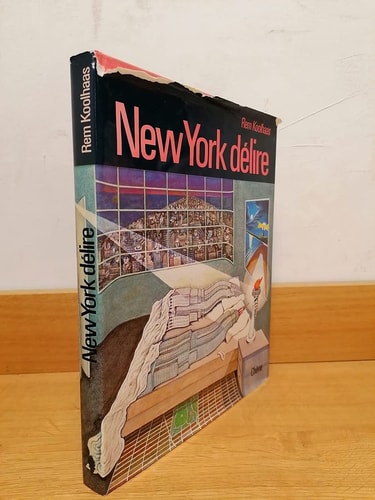
Delirious New York: A Retroactive Manifesto for Manhattan
0
0
As an Amazon Associate and affiliate partner, Menrva Books earns from qualifying purchases. Learn more
Author Description
This lovely and informative 264 page book traces the history of Manhattan from 1850 when it became a "mythical laboratory for the invention and testing of a revolutionary lifestyle: the 'Culture of Congestion.' [This book] is a polemical investigation of that Manhattan; it documents the symbiotic relationship between its mutant metropolitan culture and the unique architecture to which it gave rise. [This book] exposes the consistency and coherence of the seemingly unrelated episodes of Manhattan's urbanism; it is an interpretation that establishes Manhattan as the product of an unformulated movement, 'Manhattanism', whose true program was so outrageous that in order for it to be realized, it could never be openly declared. 'Delirious in New York' is the retroactive manifesto of Manhattan's architectural enterprise; it untangles the theories, tactics and dissimulations that allowed New York's architects to establish the desires of Manhattan's collective unconscious as realities in the Grid. It proves above all, that Manhattan has been, from the beginning, devoted to the most rational, efficient and utilitarian pursuit of the irrational. In this vision Coney Island becomes an embryonic Manhattan, testbed of a Technology of the Fantastic, the Skyscraper a self-contained universe, Manhattan a man-made archipelago of architectural islands, Rockefeller Center the first and last fragment of a definitive Manhattan. The decline of this movement sets in with the European Modernist Blitzkrieg unleashed by Le Corbusier in the mid-thirties. An appendix presents a series of projects that announce the 'second coming' of Manhattanism, this time as an explicit doctrine that can claim its place among contemporary urbanisms. An impressive documentation of original materials and unpublished projects provides the evidence for this architectural manifesto, which reads, in its insistent tracing of subconscious clues and themes, like a psychological thriller.
Menrva's Summary
THE THESIS
This work investigates the core question of how Manhattan evolved into a 'mythical laboratory' for the 'Culture of Congestion' through the lens of an unformulated movement termed 'Manhattanism'. Rem Koolhaas, a prominent architect and theorist, utilizes historical analysis and architectural critique to argue that the city's development was a rational pursuit of irrational desires. By examining the symbiotic relationship between metropolitan culture and built form, the author posits that Manhattan's urbanism is a coherent, albeit hidden, architectural manifesto. The text challenges traditional interpretations of urban growth by framing the city as a deliberate, man-made archipelago of architectural islands.
THE SCOPE MAP
What You Will Find
- Historical analysis of Manhattan's development from 1850 through the mid-twentieth century.
- Examination of the 'Culture of Congestion' as a primary driver of urban form.
- Case studies of iconic developments including Coney Island, the Skyscraper, and Rockefeller Center.
- Theoretical framework defining 'Manhattanism' as a distinct architectural doctrine.
THE AUTHORITY PERSPECTIVE
Architectural historians and urban theorists frequently cite this text as a foundational, albeit dense, critique of modern urbanism. Experts highlight the work for its unique methodology in treating urban history as a psychological narrative rather than a mere chronological record.
Page Count:
263
Publication Date:
1978-01-01
Publisher:
Oxford University Press
ISBN-10:
0195200357
ISBN-13:
9780195200355
History
Non-Fiction
Architecture
urban planning
New York
Design
United States
Community Tags
Similar Books