Nature's Last Strongholds: The Illustrated Encyclopedia of World Geography
0
0
As an Amazon Associate and affiliate partner, Menrva Books earns from qualifying purchases. Learn more
Author Description
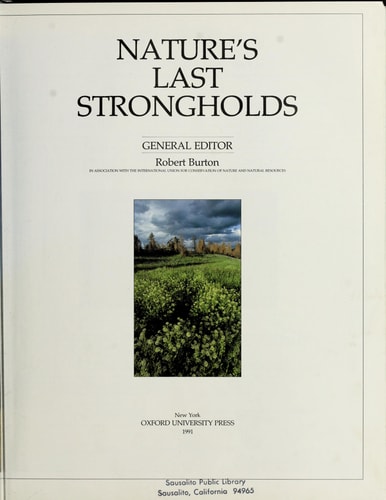
As the pace of human development accelerated and centers of civilization developed in the most fertile and cultivable areas of the world, wildernesses were regarded as unproductive and wasteful: forests had to be cleared, grasslands plowed, and wetlands drained to accommodate the world's growing populations. Even after the cataclysmic changes of the Industrial Revolution, there still appeared to be plenty of wilderness left to be plundered for its wealth of natural resources. As the scale of global environmental destruction has magnified, it has become increasing clear that the world's wildernesses must be preserved. This study reviews the distribution of the last natural refuges around the world and explains why they are vital for the health of our planet. It traces the process of global destruction from early historic times through its mass acceleration since World War II, and evaluates the steps that have been, and are being taken, to conserve and protect the world's fragile ecosystems. Lavishly illustrated with over 200 full-color illustrations, Nature's Last Strongholds is an important reminder of the ephemerality of the Earth's beauty.
Menrva's Summary
THE THESIS
This work investigates the critical necessity of preserving the world's remaining wilderness areas in the face of accelerating human development and environmental degradation. Robert Burton provides a comprehensive analysis of how global ecosystems have been systematically altered from early history through the post-World War II era. By examining the historical trajectory of resource exploitation, the author argues that these natural refuges are essential for planetary health and long-term ecological stability.
THE SCOPE MAP
What You Will Find
- A historical overview of human impact on global wilderness from early civilization to the modern industrial age.
- An evaluation of current conservation strategies and international protection efforts for fragile ecosystems.
- A geographical survey of the remaining natural strongholds across the planet.
- Over 200 full-color illustrations documenting the biodiversity and landscapes of these threatened regions.
THE AUTHORITY PERSPECTIVE
Experts and readers frequently cite this volume as a visually accessible introduction to the history of global environmental conservation. The text is noted for its balance of historical context and geographical data, making it a useful reference for those interested in the intersection of human development and ecological preservation.
Page Count:
256
Publication Date:
1991-06-13
Publisher:
Oxford University Press
ISBN-10:
0195208625
ISBN-13:
9780195208627
Nature
Nature conservation
Reference
Conservation
Natural Areas
Natural Resources
Environment
Ecology
Nature
Geography
Community Tags
Similar Books