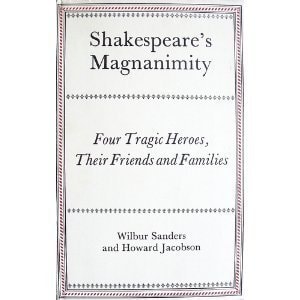
Shakespeare's Magnanimity: Four Tragic Heroes, Their Friends, and Families
0
0
As an Amazon Associate and affiliate partner, Menrva Books earns from qualifying purchases. Learn more
Author Description
The field of Shakespearean studies is cluttered with the fossils of past discussions - recorded in words and phrases like 'character,' 'themes,' 'poetic drama,' 'order,' 'vitality,' 'moral vision' and somehow or other we have to pick our way round them. In a prefatory dialogue the reader finds himself in the company of those obstructive entities and of their often amiable proponents, here attempting to state a reading of Twelfth Night and failing because of incompatible notions of 'how to read.' The brisk argument that ensues opens questions which have too long been closed. The four essays in this book, on Hamlet, Macbeth, Anthony and Cleopatra and Coriolanus, are, in the same spirit, unspecialized, free-ranging and openly argumentative. The authors' lively and entertaining procedure is accounted for, not as a lack of seriousness, but by their understanding that 'comedy is the friend of the serious and seeks to protect it from the preposterous.' Thus the readings are by no means always the familiar ones. The idea that Coriolanus is a thinking man, or that comic inspiration predominates in Hamlet, may surprise at first sight. But the argument is tied at all points to the text and the scene, and can be met, stimulatingly, on that ground. Shakespeare wrote out of and about a common humanity and it is with humanity, common and uncommon, that we must read or watch him. This book is accordingly addressed as much to the ordinary literate reader or playgoer as to the academic or the student.
Menrva's Summary
THE THESIS
This book investigates whether traditional academic approaches to Shakespearean tragedy have obscured the humanity of his characters by prioritizing rigid critical frameworks over the text itself. Howard Jacobson and Wilbur Sanders, both established literary critics, challenge the ossified terminology of Shakespearean studies by proposing a more direct, unspecialized engagement with the plays. They argue that by stripping away the 'fossils' of past criticism, readers can rediscover the common humanity inherent in Shakespeare's work, suggesting that even tragic figures possess a magnanimity often overlooked by conventional analysis.
THE SCOPE MAP
What You Will Find
- Critical re-evaluations of four major tragedies: Hamlet, Macbeth, Antony and Cleopatra, and Coriolanus.
- A methodological critique of how academic institutions teach and interpret Shakespearean drama.
- A series of argumentative essays that prioritize the text and scene over abstract thematic labels.
- An exploration of the role of comedy as a protective mechanism for serious dramatic themes.
THE AUTHORITY PERSPECTIVE
Critics and scholars often note the book's accessible, conversational tone, which stands in contrast to the dense, jargon-heavy prose typical of academic Shakespearean studies. It is frequently cited as a refreshing, if provocative, resource for both general readers and students who seek to move beyond traditional critical orthodoxies.
Page Count:
187
Publication Date:
1978-01-01
Publisher:
Oxford University Press
ISBN-10:
0195200659
ISBN-13:
9780195200652
Drama
Non-Fiction
Literary Criticism
Shakespeare
Community Tags
Similar Books