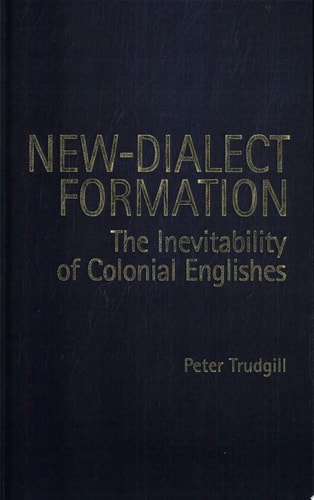
New-Dialect Formation: The Inevitability of Colonial Englishes
0
0
As an Amazon Associate and affiliate partner, Menrva Books earns from qualifying purchases. Learn more
Author Description
Distinguished sociolinguist Peter Trudgill here presents a controversial new theory about dialect contact and the formation of new colonial dialects. He examines the genesis of Latin American Spanish, Canadian French, and North American English and in particular concentrates on Australian, New Zealand, and South African English. These varieties developed during the nineteenth century along with the immigration of settlers from Britain and Ireland. The novelty of Trudgill's theory is that these new varieties of English were predictable and deterministic according to certain demographic and linguistic principles, and that all these varieties of colonial Englishes are similar to each other because they were formed out of similar mixtures according to the same principles. Trudgill argues no role in colonial dialect development and that the work of dialect formation was carried out by children over a period of two generations. Trudgill's work represents an exciting new approach to the study of language contact and dialects in its emphasis on the notion of predictability and the important role of children.
Menrva's Summary
THE THESIS
This book investigates whether the formation of new colonial dialects is a predictable and deterministic process driven by specific demographic and linguistic principles. Peter Trudgill, a distinguished sociolinguist, challenges traditional views on language evolution by proposing that colonial Englishes emerged through consistent, repeatable patterns of dialect contact. He argues that the development of these varieties was not a random occurrence but a result of specific mixtures of settler populations from Britain and Ireland. By focusing on the role of children over two generations, Trudgill provides a framework that suggests dialect formation follows an inevitable trajectory based on the linguistic input available during the settlement period.
THE SCOPE MAP
What You Will Find
- Comparative analysis of Latin American Spanish, Canadian French, and various colonial Englishes.
- Examination of nineteenth-century migration patterns from Britain and Ireland.
- A theoretical framework emphasizing demographic and linguistic predictability.
- Evidence supporting the role of children as the primary agents of dialect stabilization.
THE AUTHORITY PERSPECTIVE
Experts in sociolinguistics recognize this work as a significant contribution to the study of language contact and dialectology. Readers frequently note the academic density of the prose, which is intended for scholars and students of linguistics interested in the mechanics of language change.
Page Count:
192
Publication Date:
2004-03-25
Publisher:
Oxford University Press
ISBN-10:
0195220439
ISBN-13:
9780195220438
History
Languages In Contact
Great Britain
Language
Linguistics
Academic
English language dialects
Community Tags
Similar Books