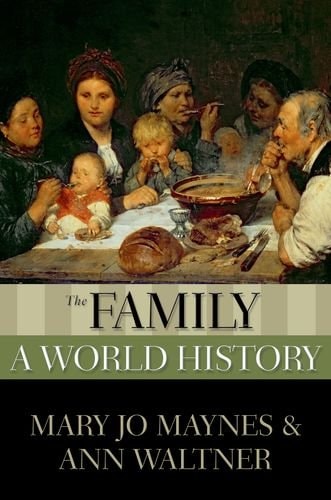
The Family: A World History
0
0
As an Amazon Associate and affiliate partner, Menrva Books earns from qualifying purchases. Learn more
Author Description
People have always lived in families, but what that means has varied dramatically across time and cultures. The family is not a "natural" phenomenon but an institution with a dynamic history stretching 10,000 years into the past. Mary Jo Maynes and Ann Waltner tell the story of this fundamental unit from the beginnings of domestication and human settlement. They consider the codification of rules governing marriage in societies around the ancient world, the changing conceptions of family wrought by the heightened pace of colonialism and globalization in the modern world, and how state policies shape families today.The authors illustrate ways in which differences in gender and generation have affected family relations over the millennia. Cooperation between family members--by birth or marriage--has driven expansions of power and fusions of culture in times and places as different as ancient Mesopotamia, where kings' daughters became priestesses who mediated among the various cultures and religions of their fathers' kingdom, and sixteenth-century Mexico, in which alliances between Spanish men and indigenous women variously allowed for consolidation of colonial power or empowered resistance to colonial rule. But family discord has also driven - and been driven by - historical events such as China's 1919 May Fourth Movement, in which young people seeking an end to patriarchal authority were key participants.Maynes's and Waltner's view of the family as a force of history brings to light processes of human development and patterns of social life and allows for new insights into the human past and present.
Menrva's Summary
THE THESIS
This work investigates the family not as a static, natural phenomenon, but as a dynamic institution that has evolved significantly over the past 10,000 years. Mary Jo Maynes and Ann Waltner, both established scholars in history and social science, utilize a comparative global framework to analyze how family structures have functioned as primary drivers of historical change. By examining the intersection of gender, generation, and state policy, the authors argue that the family unit has been central to the expansion of power, cultural fusion, and social resistance throughout human history.
THE SCOPE MAP
What You Will Find
- A 10,000-year historical survey of family structures from early human settlement to the modern era.
- Analysis of how state policies and legal codes have historically regulated marriage and kinship.
- Comparative case studies ranging from ancient Mesopotamia and sixteenth-century Mexico to twentieth-century China.
- Examination of how gender and generational dynamics influence political power and social stability.
THE AUTHORITY PERSPECTIVE
Experts recognize this text as a foundational contribution to the New Oxford World History series, noting its ability to synthesize vast historical data into a coherent social framework. Readers frequently highlight the clarity of the authors' arguments regarding the family's role in shaping global political and cultural landscapes.
Page Count:
168
Publication Date:
2012-01-01
Publisher:
Oxford University Press
ISBN-10:
0195304764
ISBN-13:
9780195304763
History
Social Science
World history
Family history
Sociology
Family Studies
Community Tags
Similar Books