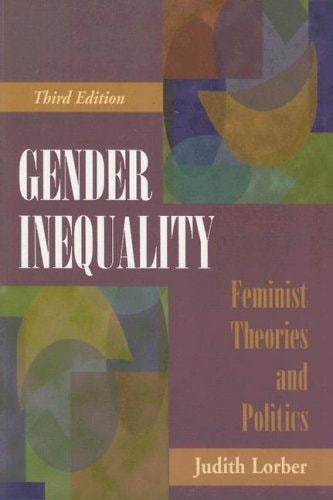
Gender Inequality: Feminist Theories and Politics
0
0
As an Amazon Associate and affiliate partner, Menrva Books earns from qualifying purchases. Learn more
Author Description
Is feminism dead, or has it gone mainstream? Are we into a third wave or still in the second wave? What did feminism accomplish in the past 40 years? What still needs to be done about persistent gender inequality? Do we need a new feminism?In Gender Inequality: Feminist Theories and Politics, Judith Lorber examines the various theories that have been developed to address the sources of gender inequality. She uncovers how these various theories have diverged and converged to form a political movement in the second wave of feminism.In this lively text, Lorber acknowledges feminism's significant contributions to redressing gender inequality, celebrates its enormous accomplishments over the last forty years, documents its ongoing political activism, and--with an awareness of postmodern and third-wave trends--points toward its future.Organized into three typologies, Gender Inequality provides an analysis of thirteen types of feminism and includes two provocative excerpts from primary sources to further enhance each chapter. Lorber also includes checklists for sources of gender inequality, politics, and contributions to social change for each feminist perspective.Throughout, the text documents the sources and the politics of gender inequality, as seen by a variety of feminisms: gender reform feminisms (liberal, Marxist, socialist, post-colonial), who want to purge the gendered social order of practices that discriminate against women; gender resistance feminisms (radical, lesbian, psychoanalytic, standpoint), who want women's voices and perspectives to reshape the gendered social order; and gender rebellion feminisms (multicultural/multiracial, feminist studies of men, social construction, postmodern, third wave), who want to destroy the gendered social order by multiplying genders or doing away with them entirely.The text's rich pedagogical features include a glossary, an index, updated and expanded text and readings lists, and updated Internet sources.
Menrva's Summary
THE THESIS
This text investigates the multifaceted origins of gender inequality and the diverse theoretical frameworks that have shaped feminist political movements over the last four decades. Dr. Judith Lorber, a prominent sociologist, synthesizes decades of academic discourse to evaluate how various feminist schools of thought have addressed systemic discrimination. By categorizing these theories into distinct typologies, the author provides a structured framework for understanding the evolution of feminist activism from the second wave to contemporary postmodern trends.
THE SCOPE MAP
What You Will Find
- A classification of thirteen distinct types of feminism organized into three primary typologies: gender reform, gender resistance, and gender rebellion.
- Pedagogical tools including chapter-specific checklists for identifying sources of inequality and evaluating political contributions to social change.
- Primary source excerpts integrated into each chapter to provide direct engagement with foundational feminist arguments.
- A comprehensive analysis of the historical accomplishments of the feminist movement and its ongoing trajectory in the face of persistent social stratification.
THE AUTHORITY PERSPECTIVE
Scholars and students frequently cite this work as a foundational text for navigating the complex landscape of feminist theory. The text is noted for its clear, pedagogical structure, making it an accessible resource for those seeking to understand the divergence and convergence of various political strategies within the movement.
Page Count:
344
Publication Date:
2005-03-15
Publisher:
Oxford University Press
ISBN-10:
019533051X
ISBN-13:
9780195330519
Social Theory
Sociology
Gender Studies
Sex Role
Feminist Theory
Sex Discrimination Against Women
Feminism
Women
Community Tags
Similar Books