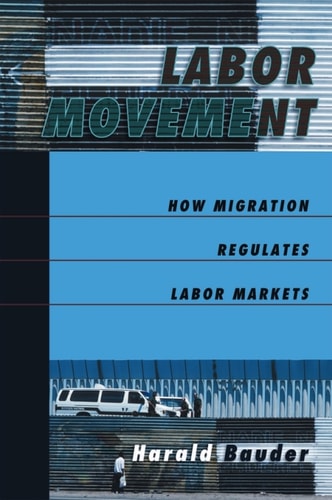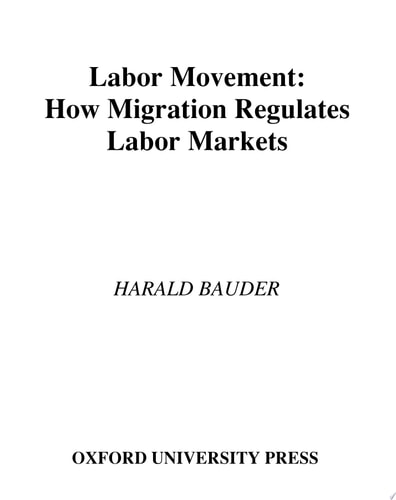
Labor Movement
0
0
As an Amazon Associate and affiliate partner, Menrva Books earns from qualifying purchases. Learn more
Author Description
Throughout The Industrialized World, International Migrants Serve As Nannies, Construction Workers, Gardeners And Small-business Entrepreneurs. Labor Movement Suggests That The International Migration Of Workers Is Necessary For The Survival Of Industrialized Economies. The Book Thus Turns The Conventional View Of International Migration On Its Head: It Investigates How Migration Regulates Labor Markets, Rather Than Labor Markets Shaping Migration Flows. Assuming A Critical View Of Orthodox Economic Theory, The Book Illustrates How Different Legal, Social And Cultural Strategies Towards International Migrants Are Deployed And Coordinated Within The Wider Neo-liberal Project To Render Migrants And Immigrants Vulnerable, Pushing Them Into Performing Distinct Economic Roles And Into Subordinate Labor Market Situations. Drawing On Social Theories Associated With Pierre Bourdieu And Other Prominent Thinkers, Labor Movement Suggests That Migration Regulates Labor Markets Through Processes Of Social Distinction, Cultural Judgement And The Strategic Deployment Of Citizenship. European And North American Case Studies Illustrate How The Labor Of International Migrants Is Systematically Devalued And How Popular Discourse Legitimates The Demotion Of Migrants To Subordinate Labor. Engaging With Various Immigrant Groups In Different Cities, Including South Asian Immigrants In Vancouver, Foreigners And Spätaussiedler In Berlin, And Mexican And Caribbean Offshore Workers In Rural Ontario, The Studies Seek To Unravel The Complex Web Of Regulatory Labor Market Processes Related To International Migration. Recognizing And Understanding These Processes, Bauder Argues, Is An Important Step Towards Building Effective Activist Strategies And For Envisioning New Roles For Migrating Workers And People. The Book Is A Valuable Resource To Researchers And Students In Economics, Ethnic And Migration Studies, Geography, Sociology, Political Science, And To Frontline Activists In Europe, North America.
Menrva's Summary
THE THESIS
This book investigates the core question of how international migration functions as a regulatory mechanism for labor markets within industrialized economies. Harald Bauder, a scholar in geography and migration studies, challenges orthodox economic theory by arguing that migration is not merely a response to market demand but a structural necessity for the survival of neo-liberal economies. By applying social theories from thinkers like Pierre Bourdieu, the author examines how legal, social, and cultural strategies are deployed to render migrant workers vulnerable and subordinate within the global economic framework.
THE SCOPE MAP
What You Will Find
- Analysis of how citizenship and social distinction are strategically used to regulate labor markets.
- Case studies of immigrant groups in Vancouver, Berlin, and rural Ontario.
- Examination of the neo-liberal project and its role in devaluing migrant labor.
- Theoretical framework connecting social theory to contemporary economic labor practices.
THE AUTHORITY PERSPECTIVE
Scholars and students in the social sciences frequently cite this work for its critical approach to migration and its application of Bourdieu’s theories to labor market regulation. Experts highlight the text as a significant contribution to understanding the intersection of political economy and migration policy.
Page Count:
288
Publication Date:
2006-01-01
Publisher:
Oxford University Press
ISBN-10:
019534622X
ISBN-13:
9780195346220
Economics
Geography
Sociology
Labor Studies
Migration Studies
Community Tags
Similar Books