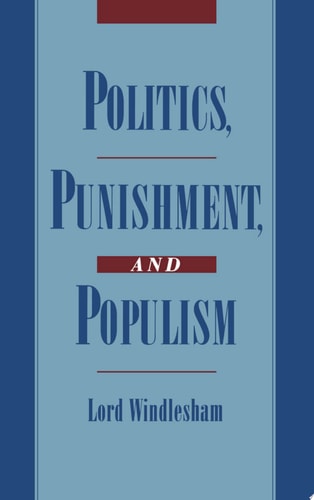
Politics, Punishment, and Populism
0
0
As an Amazon Associate and affiliate partner, Menrva Books earns from qualifying purchases. Learn more
Author Description
The Violent Crime Control and Law Enforcement Act of 1994 was arguably the most important legislative achievement of President Clinton's first term. In this detailed account, Lord Windlesham, a prominent legal scholar, British legislator, and Oxford College Principal, brings his experience to bear in analyzing the forces inside and outside the 103rd Congress, which shaped the final content of the Act. Controversial issues discussed include racial justice, "three strikes and you're out" and mandatory sentencing, the Brady Act and the assault weapons ban, the competing claims of prison building and prevention programs, drug policies, and restrictions on repeat sex offenders after release from prison. The narrative of Politics, Punishment, and Populism continues with the "Contract with America" and the crime policies adopted after the Republicans won control of both the House and Senate in the elections for the 104th Congress. The external pressures, and the Congressional tactics deployed to facilitate passage of such measures as the Antiterrorism and Effective Death Penalty Act, Megan's Law, and the Prison Litigation Reform Act, are examined in the second part of the book. Subsequent challenges in the courts are also reviewed, including some cases decided by the Supreme Court at the end of its 1996-97 term. The focal point throughout is the impact of populist opinion, as well as that of special-interest groups, upon elected representatives in the formation of public policy. The role of one of the most politically potent of all lobbies, the National Rifle Association, is assessed in the context of the competition it faces from an increasingly activist gun control movement. The book concludes by asking whether an end is in sight regarding America's isolated tolerance of lethal weapons.
Menrva's Summary
THE THESIS
This work investigates how populist sentiment and special-interest lobbying influenced the formation of American crime legislation during the mid-1990s. Lord Windlesham, a distinguished British legal scholar and legislator, utilizes his extensive background in public policy to dissect the legislative mechanics behind the 1994 Violent Crime Control and Law Enforcement Act and subsequent policy shifts. He argues that the intersection of electoral pressure and aggressive lobbying fundamentally altered the landscape of American criminal justice, moving it toward more punitive measures.
THE SCOPE MAP
What You Will Find
- Detailed analysis of the 1994 Violent Crime Control and Law Enforcement Act and the 104th Congress crime policies.
- Examination of the influence exerted by the National Rifle Association and gun control advocacy groups.
- Case studies on mandatory sentencing, the Brady Act, and the Antiterrorism and Effective Death Penalty Act.
- Review of Supreme Court challenges regarding legislative reforms from the 1996-97 term.
THE AUTHORITY PERSPECTIVE
Experts recognize this text as a rigorous, comparative study of American legislative processes from a seasoned international perspective. Readers frequently note the academic density of the prose, which provides a comprehensive look at the intersection of political populism and criminal justice reform.
Page Count:
288
Publication Date:
1998-01-01
Publisher:
Oxford University Press
ISBN-10:
0195354028
ISBN-13:
9780195354027
History
Politics
Sociology
Law
Public Policy
Criminology
Community Tags
Similar Books