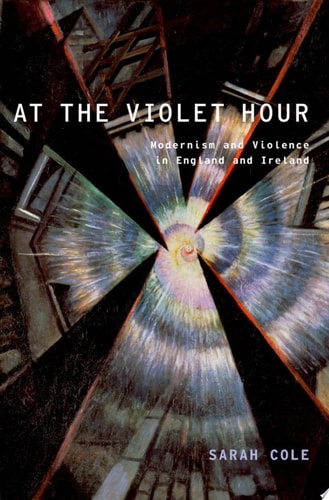
At the Violet Hour: Modernism and Violence in England and Ireland
0
0
As an Amazon Associate and affiliate partner, Menrva Books earns from qualifying purchases. Learn more
Author Description
Literature has long sought to make sense of the destruction and aggression wrought by human civilization. Yet no single literary movement was more powerfully shaped by violence than modernism. As Sarah Cole shows, modernism emerged as an imaginative response to the devastating events that defined the period, including the chaos of anarchist bombings, World War I, the Irish uprising, and the Spanish Civil War. Combining historical detail with resourceful readings of fiction, poetry, journalism, photographs, and other cultural materials, At the Violet Hour explores the strange intimacy between modernist aesthetics and violence in the late nineteenth and early twentieth centuries.The First World War and T. S. Eliot's The Waste Land demonstrate the new theoretical paradigm that Cole deploys throughout her study, what she calls "enchanted" and "disenchanted" violence-the polarizing perceptions of violent death as either the fuel for regeneration or the emblem of grotesque loss. These concepts thread through the literary-historical moments that form the core of her study, beginning with anarchism and the advent of dynamite violence in late Victorian England. As evinced in novels by Joseph Conrad, Henry James, and others, anarchism fostered a vibrant, modern consciousness of violence entrenched in sensationalism and melodrama. A subsequent chapter offers four interpretive categories-keening, generative violence, reprisal, and allegory-for reading violence in works by W. B. Yeats, J. M. Synge, Sean O'Casey, and others around the time of Ireland's Easter Rising. The book concludes with a discussion of Virginia Woolf's oeuvre, placing the author in two primary relations to the encroaching culture of violence: deeply exploring and formalizing its registers; and veering away from her peers to construct an original set of patterns to accommodate its visceral ubiquity in the years leading up to the Second World War.A rich interdisciplinary study that incorporates perspectives fro
Menrva's Summary
THE THESIS
This study investigates the complex relationship between modernist aesthetics and the pervasive violence that defined the late nineteenth and early twentieth centuries. Sarah Cole, an expert in modernist literature, utilizes a diverse array of primary sources—including fiction, poetry, journalism, and photography—to argue that modernism functioned as an imaginative response to historical trauma. She introduces a theoretical framework of 'enchanted' and 'disenchanted' violence to analyze how writers perceived death as either a regenerative force or a symbol of grotesque loss.
THE SCOPE MAP
What You Will Find
- Analysis of anarchist bombings and dynamite violence in late Victorian England.
- Interpretive categories for Irish literature including keening, generative violence, reprisal, and allegory.
- Examination of the works of Joseph Conrad, Henry James, W. B. Yeats, J. M. Synge, Sean O'Casey, and Virginia Woolf.
- A comparative study of how modernist authors responded to World War I, the Irish Easter Rising, and the Spanish Civil War.
THE AUTHORITY PERSPECTIVE
Scholars and critics recognize this work as a significant interdisciplinary contribution to the study of modernist aesthetics and historical violence. Readers frequently note the academic density of the prose and the depth of the author's historical research.
Page Count:
400
Publication Date:
2012-11-01
Publisher:
Oxford University Press
ISBN-10:
0195389611
ISBN-13:
9780195389616
History
Literary Criticism
British literature
Modernism
Authors english
Irish literature
Community Tags
Similar Books