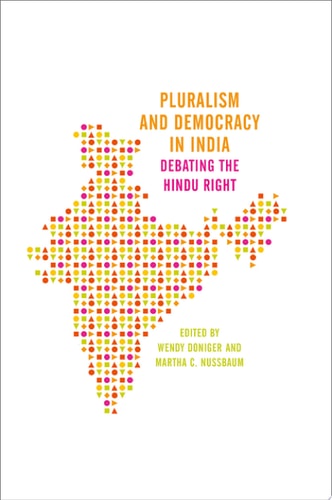
Pluralism and Democracy in India: Debating the Hindu Right
0
0
As an Amazon Associate and affiliate partner, Menrva Books earns from qualifying purchases. Learn more
Author Description
Wendy Doniger and Martha Nussbaum bring together leading scholars from a wide array of disciplines to address a crucial question: How does the world's most populous democracy survive repeated assaults on its pluralistic values? India's stunning linguistic, cultural, and religious diversity has been supported since Independence by a political structure that emphasizes equal rights for all, and protects liberties of religion and speech. But a decent Constitution does not implement itself, and challenges to these core values repeatedly arise-most recently in the form of the Hindu Right movements of the twenty-first century that threatened to destabilize the nation and upend its core values, in the wake of a notorious pogrom in the state of Gujarat in which approximately 2000 Muslim civilians were killed.Focusing on this time of tension and threat, the essays in this volume consider how a pluralistic democracy managed to survive. They examine the role of political parties and movements, including the women's movement, as well as the role of the arts, the press, the media, and a historical legacy of pluralistic thought and critical argument. Featuring essays from eminent scholars in history, religious studies, political science, economics, women's studies, and media studies, Pluralism and Democracy in India offers an urgently needed case study in democratic survival. As Nehru said of India on the eve of Independence: ''These dreams are for India, but they are also for the world.'' The analysis this volume offers illuminates not only the past and future of one nation, but the prospects of democracy for all.
Menrva's Summary
THE THESIS
This volume investigates how India’s democratic framework maintains its commitment to pluralism despite significant challenges from the Hindu Right and internal sectarian violence. Editors Martha C. Nussbaum and Wendy Doniger assemble a multidisciplinary cohort of scholars to analyze the resilience of India's constitutional values. By examining the intersection of political movements, media influence, and historical legacies, the contributors argue that the survival of Indian democracy depends on the active defense of equal rights and secular liberties against exclusionary nationalist ideologies.
THE SCOPE MAP
What You Will Find
- Analysis of the political impact of the Hindu Right movements in the twenty-first century.
- Case studies regarding the 2002 Gujarat riots and their implications for national stability.
- Evaluations of the role of the press, the arts, and the women's movement in sustaining pluralistic discourse.
- Theoretical frameworks concerning the survival of democratic institutions in diverse, post-colonial societies.
THE AUTHORITY PERSPECTIVE
Experts identify this collection as a significant interdisciplinary resource for understanding the complexities of contemporary Indian politics. Readers frequently note the academic rigor of the essays, which provide a comprehensive look at the tensions between secular constitutionalism and religious nationalism.
Page Count:
400
Publication Date:
2015-03-09
Publisher:
Oxford University Press
ISBN-10:
0195395530
ISBN-13:
9780195395532
Religion
History
Pluralism
Sociology
Democracy
India
Religious Aspects
Community Tags
Similar Books