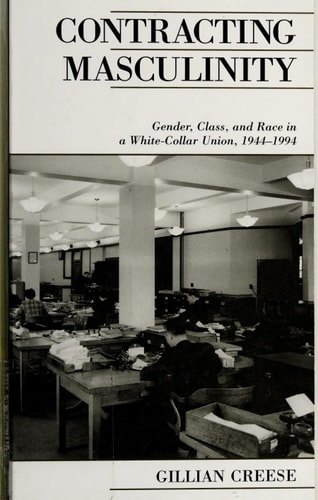
Contracting Masculinity: Gender, Class, and Race in a White-Collar Union, 1944-1994
0
0
As an Amazon Associate and affiliate partner, Menrva Books earns from qualifying purchases. Learn more
Author Description
The history of labor in Canada is most often understood to mean--and presented as--the history of blue-collar men. And it is a story of union solidarity to gain wages, rights, and the like from employers. Creese here examines in depth one white-collar office union, and shows how collective bargaining involves negotiating relations of gender, class and race.
Menrva's Summary
THE THESIS
How do the intersections of gender, class, and race shape the internal dynamics and collective bargaining strategies of white-collar labor unions? Gillian Creese, a scholar of sociology and labor history, utilizes a detailed case study of a specific white-collar office union to challenge the traditional male-centric narrative of Canadian labor history. By analyzing fifty years of union activity, the author argues that collective bargaining is not merely an economic negotiation with employers, but a complex social process that reinforces or challenges existing hierarchies of identity within the workplace.
THE SCOPE MAP
What You Will Find
- A longitudinal study of a white-collar office union spanning from 1944 to 1994.
- Analysis of the shifting demographics of the workforce and their impact on union policy.
- Primary source research including union records, meeting minutes, and internal correspondence.
- A theoretical framework examining the intersectionality of gender, class, and race in organizational structures.
THE AUTHORITY PERSPECTIVE
Scholars in the field of labor history identify this work as a significant contribution to understanding the often-overlooked experiences of white-collar workers. The text is frequently cited for its rigorous application of intersectional theory to historical labor data, making it a standard reference for students of Canadian social history.
Page Count:
288
Publication Date:
1999-07-08
Publisher:
Oxford University Press
ISBN-10:
0195414543
ISBN-13:
9780195414547
History
Labor history
Gender Studies
Social Classes
Sociology
Race
Social History
Canadian History
Labor unions
Community Tags
Similar Books