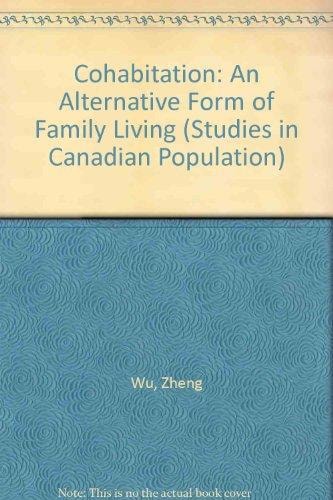
Cohabitation: An Alternative Form of Family Living
0
0
As an Amazon Associate and affiliate partner, Menrva Books earns from qualifying purchases. Learn more
Author Description
Perhaps no social phenomenon reflects more clearly the changing values in modern society than cohabitation, that is, a heterosexual couple living together outside of marriage. In Cohabitation: An Alternative Form of Family Living, Zheng Wu examines the implications of this phenomenon from the points of view of sociology, demography, and economics, using data from the Canadian census, the 1990 and 1995 cycles of the General Social Survey, and the 1984 Canadian Fertility Survey. Topics include cohabitation trends, shifting attitudes in the populace, how and why people choose cohabitation as an alternative to or 'trial' for marriage, child-bearing, the breakup of relationships, the individual and societal consequences of cohabitation, and the future of this form of family living. In the concluding chapter, the book consideres also the legal and public policy implications of this deep demographic shift.
Menrva's Summary
THE THESIS
This book investigates the sociological, demographic, and economic implications of cohabitation as a significant shift in modern family structures. Zheng Wu, a scholar specializing in population studies, utilizes extensive data sets from the Canadian census and various General Social Surveys to analyze the motivations and consequences behind couples choosing to live together outside of marriage. The work provides a comprehensive framework for understanding how cohabitation functions as both an alternative to and a precursor for traditional marriage in contemporary society.
THE SCOPE MAP
What You Will Find
- Analysis of cohabitation trends and shifting public attitudes in Canada.
- Examination of child-bearing patterns and relationship stability within cohabiting unions.
- Utilization of empirical data from the Canadian census and the General Social Survey.
- Discussion of legal and public policy implications resulting from demographic changes.
THE AUTHORITY PERSPECTIVE
Experts recognize this work as a foundational text for understanding the demographic transition of family life in Canada. Readers frequently note the academic rigor and the clear, data-driven approach used to explain complex social shifts.
Page Count:
208
Publication Date:
2001-08-16
Publisher:
Oxford University Press
ISBN-10:
0195413784
ISBN-13:
9780195413786
Economics
Family Studies
Demography
Unmarried Couples
Sociology
Community Tags
Similar Books