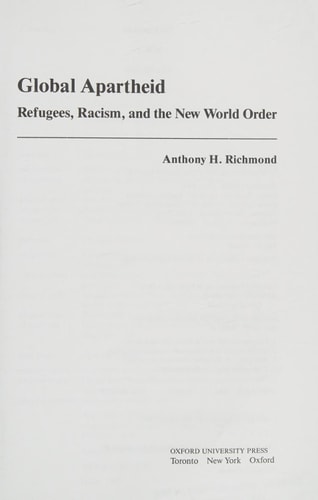
Global Apartheid: Refugees, Racism, and the New World Order
0
0
As an Amazon Associate and affiliate partner, Menrva Books earns from qualifying purchases. Learn more
Author Description
Refugees are a growing element in the population movements that result from ethnic conflicts, civil wars, and environmental disasters. The economically privileged seek to protect their advantage, while the deprived fight for their share. "Global apartheid" is how Richmond describes some host countries' response to these conflicts by creating barriers designed to stem the flow of migrants and protect the power, benefits, and status of the host societies. This work examines the impact of postindustrialism, postmodernism, and globalization on international migration, racial conflict, and ethnic nationalism.
Menrva's Summary
THE THESIS
This work investigates the mechanisms of global inequality and the exclusionary policies adopted by affluent nations in response to mass migration and ethnic conflict. Anthony H. Richmond, a sociologist specializing in migration and ethnic relations, utilizes a framework of postindustrialism and globalization to analyze how host societies construct barriers against displaced populations. He argues that these systemic responses function as a form of global apartheid, designed to preserve the socioeconomic advantages of the privileged against the pressures of international displacement.
THE SCOPE MAP
What You Will Find
- Analysis of the intersection between postindustrial economic structures and international migration patterns.
- Examination of the rise of ethnic nationalism and racial conflict in the context of globalized labor markets.
- Evaluation of state-level policies designed to restrict refugee movement and protect domestic status.
- Theoretical exploration of how postmodernism influences the perception of national borders and identity.
THE AUTHORITY PERSPECTIVE
Experts recognize this text as a critical contribution to the sociological study of migration and geopolitical inequality. Readers frequently note the academic density of the prose and the author's rigorous application of structural theory to contemporary global crises.
Page Count:
342
Publication Date:
1995-01-12
Publisher:
Oxford University Press
ISBN-10:
0195410130
ISBN-13:
9780195410136
Migration
Globalization
International relations
Sociology
Race Relations
Racism
Community Tags
Similar Books