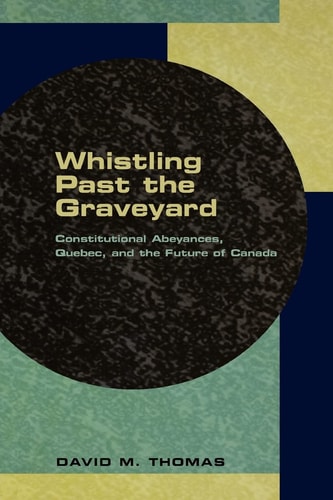
Whistling Past the Graveyard: Constitutional Abeyances, Quebec, and the Future of Canada
0
0
As an Amazon Associate and affiliate partner, Menrva Books earns from qualifying purchases. Learn more
Author Description
After 1867, for almost a hundred years, Canada was able to leave unresolved certain key constitutional questions. However, many of these issues have recently returned to the surface. One in particular--the role and place of Quebec--threatens to tear the country apart. Why was this issue avoided for so long, how has Canada tried to deal with it, and what is to be done now? This book explores these and other questions in light of Canada's constitutional past and political present.
Menrva's Summary
THE THESIS
This book investigates the historical origins and contemporary implications of Canada's constitutional abeyances, specifically focusing on the unresolved status of Quebec within the federal framework. David M. Thomas, a scholar of Canadian political institutions, examines the strategic avoidance of constitutional clarity that characterized the century following Confederation. By analyzing the shift from historical ambiguity to modern political volatility, the author argues that the persistent failure to address Quebec's role poses a fundamental threat to the stability of the Canadian state.
THE SCOPE MAP
What You Will Find
- Historical analysis of Canadian constitutional development from 1867 to the present.
- Examination of the concept of constitutional abeyance as a political tool.
- Case studies regarding the evolving relationship between Quebec and the federal government.
- Evaluation of potential pathways for future constitutional reform and national unity.
THE AUTHORITY PERSPECTIVE
Experts identify this work as a significant contribution to the study of Canadian federalism and constitutional theory. Readers frequently note the clarity with which Thomas navigates complex legal and political history to explain current national tensions.
Page Count:
296
Publication Date:
1998-01-15
Publisher:
Oxford University Press
ISBN-10:
019541215X
ISBN-13:
9780195412154
History
Quebec History
Politics & Government
Canadian History
Government
Constitutional Law
Constitutional History
Community Tags
Similar Books