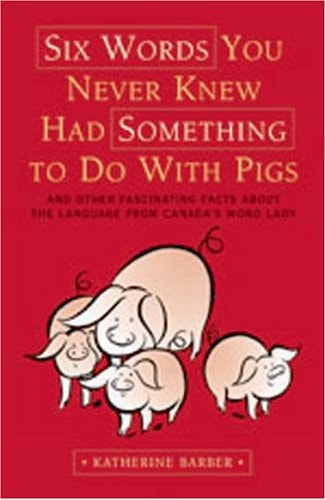
Six Words You Never Knew Had Something to Do with Pigs And Other Fascinating Facts about the Language from Canada's Word Lady
0
0
As an Amazon Associate and affiliate partner, Menrva Books earns from qualifying purchases. Learn more
Author Description
Did you know that the word "travel" is derived from an instrument of torture? That "tragedy" originally was something to do with goats? That "grammar" and "glamour" started out as one and the same word? These and many other fascinating and surprising tidbits about the history of words are revealed in this delightful volume, many culled from interviews first aired on CBC Radio 1, featuring the "Word Lady", Editor-in-Chief of the Canadian Oxford Dictionary, Katherine Barber. In the lively, witty, and entertaining style that has won her so many fans in Canada and throughout the world, Katherine distills the rich information contained in the immense Oxford English Dictionary to create intriguing and entertaining little histories of hundreds of the most common (and interesting) words in our language. The words are arranged thematically by season. Readers can frolic through the many words from the barnyard, the garden, and the cottage in the Spring; feast on Summer's fruits and all of the colourful stories to be found there; gear up for back-to-school by learning the truth behind algebra, grammar, and dunces; and discover the real reason that Christmas shopping is always such a feverish pursuit. Along the way, you'll follow words back through Old English, medieval French, Anglo-Saxon, ancient Greek, Arabic, as well as the languages of China, the Indian subcontinent, and Canada's Aboriginal peoples. With its accessible, conversational style and captivating content, Katherine Barber's Six Words You Never Knew Had Something to do with Pigs is a book you'll want to dip into time and again - that is, if you can ever put it down.
Menrva's Summary
THE THESIS
This book investigates the hidden etymological histories of common English words to reveal how language evolves through cultural and historical shifts. Katherine Barber, the Editor-in-Chief of the Canadian Oxford Dictionary, utilizes her extensive lexicographical background to distill complex linguistic data into accessible narratives. By tracing words back to their roots in Old English, Greek, Arabic, and other global languages, she provides a framework for understanding the interconnectedness of modern vocabulary. The text organizes these histories thematically by season to demonstrate the fluidity of language in everyday life.
THE SCOPE MAP
What You Will Find
- Etymological origins of over 500 common words, ranging from seasonal terms to academic vocabulary.
- A thematic organizational structure that groups word histories by the four seasons.
- Historical analysis of linguistic shifts across diverse cultures, including Anglo-Saxon, medieval French, and Indigenous Canadian influences.
- Insights into the evolution of specific terms like 'grammar', 'tragedy', and 'travel'.
THE AUTHORITY PERSPECTIVE
Critics and readers frequently praise the book for its accessible, witty tone that avoids the dryness often associated with academic etymology. Experts highlight this as a successful bridge between scholarly lexicography and popular interest, making it a standard recommendation for those interested in the history of the English language.
Page Count:
240
Publication Date:
2007-01-01
Publisher:
Oxford University Press
ISBN-10:
0195427084
ISBN-13:
9780195427080
Non-Fiction
Etymology
Words Language & Grammar
Writing
Language
Writing Guides
Linguistics
Reference
Community Tags
Similar Books