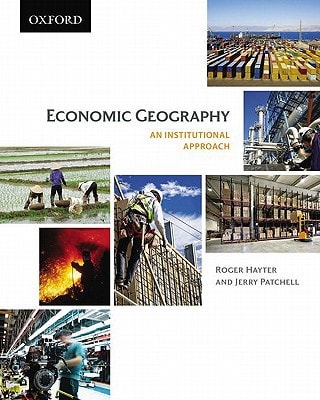
Economic Geography: An Institutional Approach
0
0
As an Amazon Associate and affiliate partner, Menrva Books earns from qualifying purchases. Learn more
Author Description
The market is the central institution of the global economy, driving the development that has so dramatically improved living standards for many of the world's people over the past two centuries. But the market has also helped to keep many other people in poverty, and it has played a major role in the ongoing degradation of the environment. In Economic Geography: An Institutional Approach, Roger Hayter and Jerry Patchell offer a comprehensive introduction to the study of economic activity in place and across space, centred on the interplay of the economic, social, and political institutions that do so much to determine the quality of life in a particular place: from its economic efficiency to the degree of social equity it enjoys and its position in what is now a global economic system. Perfect for courses in economic geography, the text provides both a solid foundation in the location dynamics of value chains and a perspective that recognizes the interdependence of places, institutions, activities, and ways of life around the world.
Menrva's Summary
THE THESIS
This text investigates how the interplay of economic, social, and political institutions determines the spatial distribution of economic activity and the resulting quality of life across different regions. Authors Jerry Patchell and Roger Hayter utilize an institutional framework to analyze how global market dynamics influence local development. By examining the interdependence of value chains and regional governance, the authors argue that economic outcomes are not merely products of market forces but are deeply embedded in the institutional structures of specific places. The book provides a comprehensive overview of how these systems shape global economic inequality and environmental sustainability.
THE SCOPE MAP
What You Will Find
- Analysis of location dynamics within global value chains
- Examination of the role of social and political institutions in economic development
- Discussion on the relationship between economic efficiency and social equity
- Theoretical framework for understanding the spatial organization of economic activity
THE AUTHORITY PERSPECTIVE
Experts recognize this work as a foundational text for students of economic geography, noting its clear synthesis of complex institutional theories. Readers frequently highlight the book's ability to bridge the gap between abstract economic models and the tangible realities of global development.
Page Count:
388
Publication Date:
2011-04-25
Publisher:
Oxford University Press
ISBN-10:
0195433793
ISBN-13:
9780195433791
Economics
Social Science
Globalization
Geography
Community Tags
Similar Books