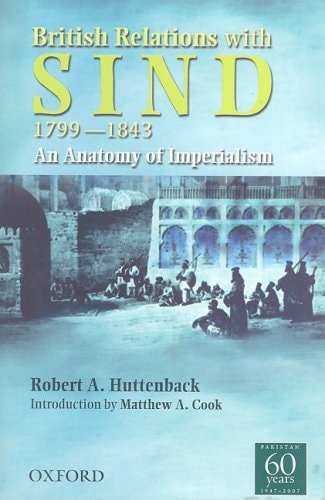
British Relations with Sind 1799-1843: An Anatomy of Imperialism
0
0
As an Amazon Associate and affiliate partner, Menrva Books earns from qualifying purchases. Learn more
Author Description
One of the major paradoxes of the nineteenth century was the continued growth of the British Empire at a time when the home authorities opposed expansion. The annexation of the Indian state of Sindh in 1843 is a notable examples of forces which abetted this situation. Huttenback's study of British relations with an independent Sindh from 1799 to 1843 provides valuable insight into the complexities of nineteenth-century British imperialism. Here is a thorough investigation of British activities in Sindh after 1799, the actual conquest, and subsequent repercussions. Huttenback presents the whole scope of British relations with Sindh from 1799 to 1843 without sacrificing the pre-annexation issues to the more romantic circumstances surrounding Sir Charles Napier and the conquest. The author is acutely aware of the dominant influences of individuals in Sindh during this critical period. The motives, characteristics, and actions of major personalities are expertly drawn. He devotes great care to an honest appraisal of the role of Sir Charles Napier, commander of the British troops in Sindh and responsible for the eventual conquest of Sindh. However, the author point out that, "Actually Napier was only the last if most important actor in a drama the significance of which has never been duly appreciated." The period involved is less than fifty years and in this short interval virtually all the factors which prompted British expansion on continents and in places far removed from the Indus Valley manifested themselves in Sindh. Among these were considerations of trade, communications, and defense, all of which fostered tensions between Great Britain and Sindh. But of prime importance was the great power of the "man on the spot," and it was the arrival of Sir Charles Napier which spurred events inexorably toward hostilities.
Menrva's Summary
THE THESIS
How did the British Empire expand into Sindh between 1799 and 1843 despite official opposition from home authorities? Robert A. Huttenback, a historian specializing in British imperial history, utilizes primary source documentation to analyze the geopolitical and personal factors that drove this annexation. He argues that the expansion was not merely a product of central policy but was heavily influenced by the autonomous actions of individuals on the ground, specifically Sir Charles Napier, within the broader context of trade, defense, and communication concerns.
THE SCOPE MAP
What You Will Find
- A detailed historical analysis of British-Sindh relations from 1799 to 1843.
- An examination of the "man on the spot" theory of imperial expansion.
- Case studies on the influence of key personalities, including Sir Charles Napier.
- An investigation into the economic and strategic motivations for territorial acquisition.
THE AUTHORITY PERSPECTIVE
Scholars and historians recognize this work as a significant contribution to the study of nineteenth-century British imperial mechanics. Readers frequently note the academic rigor and the author's balanced approach to assessing both individual agency and systemic imperial pressures.
Page Count:
153
Publication Date:
2008-04-28
Publisher:
Oxford University Press
ISBN-10:
019547399X
ISBN-13:
9780195473995
History
British Empire
India
Imperialism
Pakistan
Military History
Community Tags
Similar Books