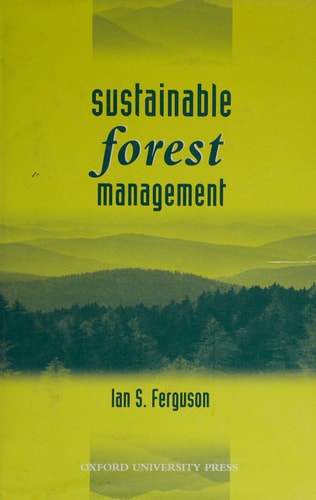
Sustainable Forest Management
0
0
As an Amazon Associate and affiliate partner, Menrva Books earns from qualifying purchases. Learn more
Author Description
The polar extremes of conservation and development of publicly owned native forests are vigorously argued by the respective interest groups. Biodiversity, climate change, protecting rare and endangered species and ecosystems, ecotourism, water quality, protecting the interests of indigenous people, sustainable management, economic development, and ensuring community stability are but a few of the issues raised by these groups. International agreements are being pursued to achieve sustainable management of tropical forests, most of which are publicly owned, by 2000. Similar measures have been proposed for temperate forests. Rational resolution of these controversies is not simple because many of the variables are difficult to define and measure, the time periods involved are long and clouded by uncertainties, and the institutional processes are complex. This book represents an attempt to integrate knowledge and processes relating to forest management across a wide range of disciplines. Written for people interested in environmental management issues to studying environmental science, natural resources, or land and forest management, its principal aim is to critically review and synthesize the underlying elements of these controversies and to place them within an ordered framework of processes for choice. It doesn't provide a universal solution, but rather contributes to a better understanding and analysis of the issues. This may seem at odds with the title of a book, but such an understanding is the very essence of sustainable management.
Menrva's Summary
THE THESIS
This book investigates the complex intersection of conservation, economic development, and institutional policy within the management of publicly owned native forests. Ian S. Ferguson, an expert in forest economics and management, synthesizes diverse scientific and socio-political data to construct a framework for decision-making. The text argues that sustainable management is not a static goal but a continuous process of analysis that must account for long-term uncertainties and competing stakeholder interests.
THE SCOPE MAP
What You Will Find
- Analysis of international agreements regarding tropical and temperate forest management.
- A multi-disciplinary framework for evaluating biodiversity, water quality, and economic stability.
- Examination of the institutional processes that govern land use and resource allocation.
- Synthesis of variables related to climate change and the protection of endangered ecosystems.
THE AUTHORITY PERSPECTIVE
Experts recognize this work as a foundational text for students and professionals navigating the complexities of natural resource policy. Readers frequently note the academic rigor of the prose and the author's balanced approach to reconciling conflicting environmental and economic priorities.
Page Count:
176
Publication Date:
1996-11-28
Publisher:
Oxford University Press
ISBN-10:
0195536045
ISBN-13:
9780195536041
Forestry
Sustainability
Forest Policy
Natural Resources
Community Tags
Similar Books